Dominican Republic 915-928 MHz: INDOTEL ISM Consultation
Dominican Republic Consults on 915–928 MHz Operating Rules for Low Power, RFID and ISM Devices
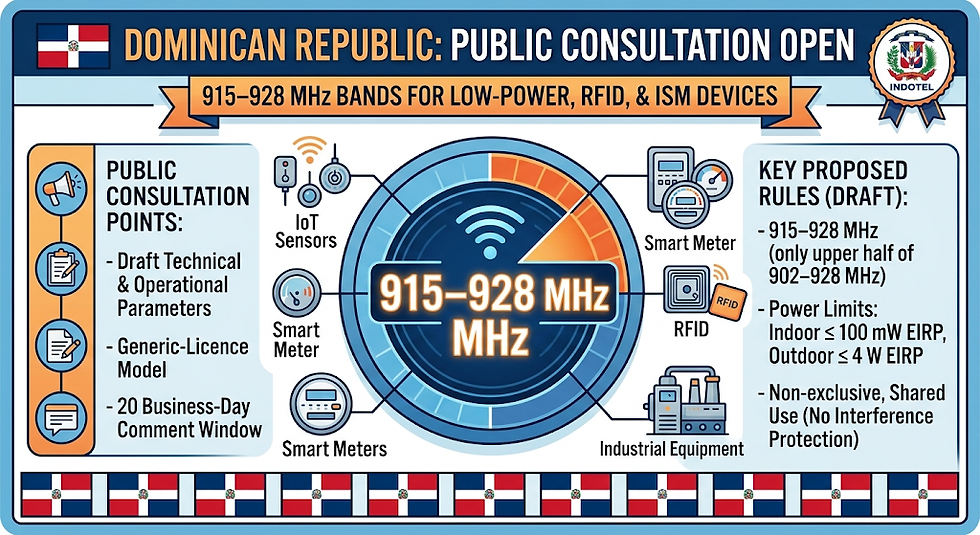
The Dominican Institute of Telecommunications (INDOTEL) has opened a public consultation on draft technical and operational parameters for low power and industrial, scientific and medical (ISM) equipment operating in the 915–928 MHz segment under a generic licence regime. The consultation was ordered by Resolution 051-2026 of the INDOTEL Consejo Directivo, adopted on 11 June 2026, and gives interested parties a twenty (20) business day window to submit written comments on the proposed rules.
The measure implements the country's new National Frequency Allocation Plan (PNAF), approved by Decree No. 99-26 on 13 February 2026, which for the first time designates 915–928 MHz for ISM and low power use in the Dominican Republic. For manufacturers, importers and test laboratories, this is an early stage but consequential development: it defines how RFID, IoT, telemetry and industrial radio equipment will be authorised for the Dominican market, and it sets the band scope and power limits those devices will have to meet.
Background: the PNAF and the new 915–928 MHz ICM designation
The trigger for the consultation is the new PNAF. Decree No. 99-26 introduced footnote DOM2AA, which lists the bands designated for industrial, scientific and medical (ICM) applications the Dominican regulatory term equivalent to ISM. Alongside long standing ISM bands such as 2,400–2,500 MHz and 5,725–5,875 MHz, footnote DOM2AA now includes 915–928 MHz, in each case "subject to the parameters and power limits established by INDOTEL." In other words, the PNAF opens the band, but the operating conditions still have to be written and that is precisely what this consultation covers.
Historically, the operating parameters for generic licence ICM equipment sit in Article 26 of the General Spectrum Use Regulation (Resolution 034-2020). That article does not yet cover 915–928 MHz. In its Regulatory Impact Analysis (AIR), INDOTEL weighed three routes: leaving the gap in place (rejected as unworkable), amending Article 26 as part of a broader regulation overhaul scheduled on the March, September 2026 regulatory agenda, or issuing a standalone resolution now. INDOTEL selected the standalone resolution route so it can enable the band quickly rather than wait for the full regulation to be revised. The draft parameters are annexed to Resolution 051-2026 and are the subject of this consultation.
What the Dominican Republic 915-928 MHz consultation proposes
The draft annex sets out two core elements manufacturers should note.
First, the authorisation model is a generic licence. Equipment would operate in 915–928 MHz without an individual frequency licence or particular authorisation. The segment is expressly shared and non exclusive: its use confers no right to protection against interference and no preferential status over other users in the same band. This mirrors the license exempt approach used in comparable markets.
Second, the draft sets technical power limits for two use cases:
Indoor low power devices: equivalent isotropically radiated power (EIRP) up to 100 mW.
Outdoor devices including IoT systems, telemetry, smart metering, RFID and industrial applications a maximum transmit power of up to 1 W and EIRP of up to 4 W, referenced to a 6 dBi antenna. Where antenna gain exceeds 6 dBi, transmit power must be reduced by the same amount the gain exceeds 6 dBi, so that 4 W EIRP is never exceeded (for example, a 9 dBi antenna, 3 dB over the reference, requires a 3 dB reduction in transmit power).
INDOTEL expressly benchmarks the proposal against international practice, citing the FCC's Part 15 framework (47 CFR Part 15, including §15.247), the ACMA's AU915 arrangement in Australia, and ITU references including Report ITU-R SM.2153 and Recommendation ITU-R SM.1055.
The 915–928 MHz-only scope: the key caveat for full band 902–928 MHz devices
The single most important technical point for equipment makers is band scope. The Dominican designation covers only 915–928 MHz, 13 MHz at the top of the wider 902–928 MHz band used across much of the Americas. INDOTEL's own impact analysis flags this directly, cautioning that importers of ICM equipment should bear in mind that this is only the upper half of the band.
The practical consequence: a device engineered for the full FCC 902–928 MHz range can transmit below 915 MHz, outside the segment the Dominican Republic is authorising under this ICM designation. To be compliant for the Dominican market, such devices will generally need to be configurable or restricted to 915–928 MHz. This aligns the Dominican Republic with Australia's AU915 regional plan, which is likewise confined to 915–928 MHz, rather than with the full band US model.
What this means for manufacturers
For manufacturers and importers, the consultation signals a defined but still movable compliance target for the Dominican market. Several implications follow.
The band restriction is the headline issue. Product lines built around the full 902–928 MHz US band, particularly UHF RFID readers, LoRa/LPWAN modules and sub GHz IoT radios, should be reviewed for a 915–928 MHz operating mode or regional variant. Devices that cannot be constrained to the upper 13 MHz are unlikely to meet the proposed Dominican conditions.
Power headroom is generous but capped. The draft's 4 W EIRP outdoor ceiling (with the antenna gain reduction rule) and 100 mW EIRP indoor limit are workable for typical IoT, telemetry and RFID deployments, but designs relying on higher EIRP or high gain antennas will need to demonstrate compliance with the reduction formula.
The generic licence model removes individual licensing friction, which lowers the administrative barrier to market entry a point INDOTEL emphasises as a benefit. The trade off is that generic licence operation carries no protection against interference, so deployments must tolerate a shared, non exclusive band.
Homologation still applies. INDOTEL states it will verify operating parameters, power limits, bandwidth and unwanted emission levels, and will review homologation certificates and technical documentation as part of spectrum monitoring and enforcement. Non compliance can lead to corrective measures, suspension of operations, or sanctions. Importers should also anticipate that conformity in this band will feed into import no objection processing through the VUCE/Customs channel.
Finally, the numbers are provisional. Because this is a draft under consultation, the power limits and conditions could change before the final resolution is adopted. Stakeholders who need specific limits for example, a higher outdoor EIRP or an alternative antenna gain treatment have a genuine window to comment.
Certification impact summary
Dimension | Position under the draft resolution |
Regulatory instrument | Draft parameters annexed to INDOTEL Resolution 051-2026 (public consultation stage) |
Authorisation model | Generic licence no individual frequency licence or particular authorisation required |
Band segment | 915–928 MHz only (13 MHz; upper half of the 902–928 MHz band) |
Interference status | Shared, non-exclusive; no protection against interference; no preferential use |
Draft indoor limit | ≤ 100 mW EIRP (low power indoor devices) |
Draft outdoor limit | ≤ 1 W transmit power and ≤ 4 W EIRP (6 dBi reference antenna); proportional power reduction above 6 dBi |
Applicable equipment | IoT, telemetry, smart metering, RFID, industrial and similar short-range devices |
Homologation | Type-approval/homologation and technical documentation subject to INDOTEL verification and enforcement |
International reference | FCC 47 CFR Part 15 (incl. §15.247); ACMA AU915; ITU-R SM.2153 / SM.1055 |
Status | Draft, parameters may change following consultation |
Timeline and required actions
Date / window | Event | Required action |
13 Feb 2026 | Decree No. 99-26 approves the new PNAF; footnote DOM2AA lists 915–928 MHz as an ICM band | Note the new band designation for the Dominican market |
11 Jun 2026 | INDOTEL Resolution 051-2026 orders the public consultation on the draft operating parameters | Review the draft annex and assess product impact |
Publication + 20 business days | Public comment window open | Submit written comments in Spanish to consultapublica@indotel.gob.do, citing Resolution 051-2026 in the subject line |
After consultation | INDOTEL adopts the final resolution establishing the parameters | Confirm final limits; prepare/update homologation dossiers |
On effectivity | Operating parameters apply to 915–928 MHz generic-licence devices | Ensure devices are restricted to 915–928 MHz; align technical documentation and import records |

