Malaysia: MCMC Licensing Regulations 2000 Consultation on Fees, Overseas Operators and Network Security
Malaysia MCMC Opens Public Consultation on the Communications and Multimedia (Licensing) Regulations 2000: New Fee Framework, Overseas Operator Fees and Mandatory Network Security Conditions
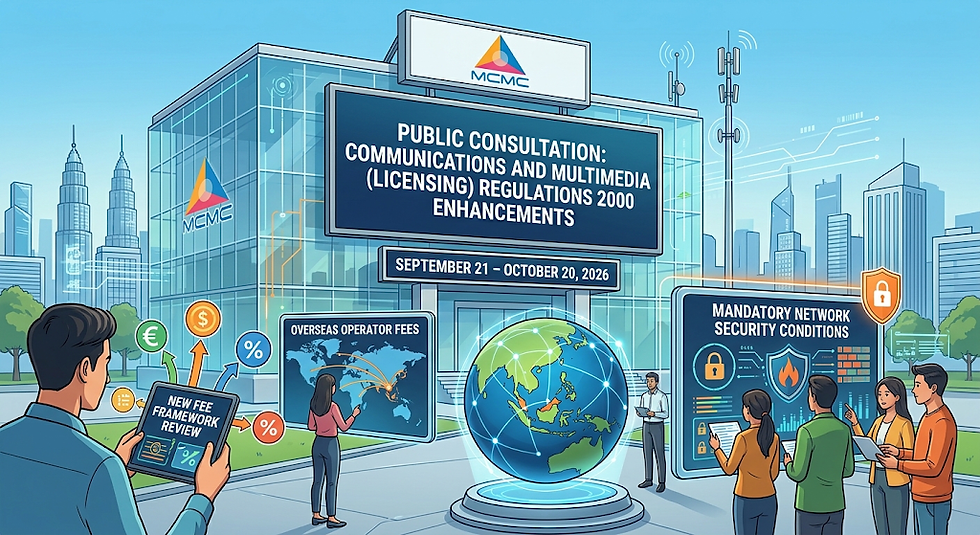
The Malaysian Communications and Multimedia Commission (MCMC) launched a public consultation on September 21, 2026, seeking stakeholder input on proposed enhancements to the Communications and Multimedia (Licensing) Regulations 2000 [P.U.(A) 129/2000]. The consultation, published under the Ministry of Communications on the Government of Malaysia's Unified Public Consultation (UPC) portal, remains open until 12:00 noon (Malaysia Time) on October 20, 2026.
This is the first comprehensive revision of Malaysia's licensing fee structure since the regulations were introduced in 2000. It follows MCMC's earlier consultation (June–July 2026) on amendments to the parent statute, the Communications and Multimedia Act 1998 (CMA), and forms part of a broader modernisation of the country's telecommunications and digital services regulatory framework.
Regulatory Background
The Licensing Regulations 2000 operationalise the licensing regime established under the CMA. Malaysia uses two main licence categories:
Individual licences, granted for higher-impact facilities and services, with more extensive conditions.
Class licences, a lighter-touch registration-based regime that covers four licence types: Network Facilities Providers (NFP), Network Service Providers (NSP), Applications Service Providers (ASP) and Content Applications Service Providers (CASP).
Since 2024, the framework has also included a deemed licensing mechanism under Section 46A of the CMA, which brings large social media and internet messaging platforms into the class licensing regime. Recent amendments to the CMA have created gaps between the Act and its subsidiary legislation, which this consultation is designed to close.
Key Changes Proposed in the MCMC Licensing Regulations 2000 Consultation
MCMC has organised the proposals under three themes.
Theme 1: Alignment with the Communications and Multimedia Act 1998
Earlier licence renewal applications: Under an amended Regulation 11, individual licensees would have to file renewal applications at least six months before expiry, instead of the current 60 days, in line with the amended Section 34(1) of the CMA.
Obligations for deemed licensees: New provisions would expressly set out what deemed licensees (social media and internet messaging providers) must submit: company and business details, a description of the relevant facilities, services or applications, details of a local representative, and proof of that representative's appointment. Deemed licensees would not pay the registration fee that applies to voluntarily registered class licensees.
Theme 2: Licence Fee Framework Review
MCMC notes that the fee framework has remained largely unchanged since 2000 and proposes to bring fees in line with the cost of licensing administration, compliance monitoring, consumer protection and enforcement.
Individual licences: A uniform increase is proposed for most fee types under Table A of the First Schedule. Approval and application fees are excluded, as they were recently revised.
Class licences: All fees in the Second Schedule would be reviewed, with a uniform increase for most fee types. The current annual registration fee of RM2,500 would be replaced by a two-tier structure:
a common rate for NSP, NFP and CASP class licences; and
a separate, higher rate for ASP class licences, reflecting the greater regulatory effort associated with services that interface directly with end users.
New regulatory fee for overseas class licensees: A new fee framework is proposed for class licensees operating from outside Malaysia, with the stated aim of creating a level playing field between domestic and foreign providers serving Malaysian users. The Minister of Communications would be empowered to prescribe these fees based on the level of regulatory oversight required.
Theme 3: Licensing Framework Modernisation and Updates
Updated definitions (Regulation 2): Obsolete and legacy references would be removed while keeping the framework technology-neutral. Proposed changes include:
removing the reference to 600 short codes from "audiotext hosting service";
removing dial-up connectivity from "internet access service";
broadening "messaging service" to cover messages in any form, not only multimedia form;
allowing "public cellular service" to cover voice and data provided together or separately; and
removing telegram, telex, ISDN and ATM references from "public switched data service".
Network security as a standard licence condition: Compliance with relevant network security requirements would become a standard condition for all individual and class licensees, regardless of category. Today, this obligation is imposed only through special licence conditions on newly issued or renewed licences.
Longer deadline for audited accounts: Individual licensees would have six months (instead of three) after their financial year-end to submit audited accounts to MCMC, aligning with the Companies Act 2016.
Certification Impact Summary
The consultation amends service licensing rules, not the technical standards or type approval procedures for communications equipment. Equipment certification in Malaysia (MCMC approval based on assessments by registered certifying agencies) is not directly changed by this instrument. The table below summarises the expected impact by area.
Area | Current position | Proposed change | Impact level |
Equipment type approval / certification | Governed by separate MCMC equipment rules and certifying agency process | No direct change in this consultation | Low (indirect only) |
Individual licence renewal | Apply 60 days before expiry | Apply 6 months before expiry | High for operators |
Individual licence fees | Largely unchanged since 2000 | Uniform increase for most fee types (approval and application fees excluded) | Medium–High |
Class licence registration fee | Flat RM2,500 per year | Two tiers: common rate for NSP/NFP/CASP, higher rate for ASP | Medium–High |
Overseas class licensees | No specific regulatory fee | New regulatory fee prescribed by the Minister | High for foreign providers |
Deemed licensees (social media, messaging) | Obligations not detailed in the Regulations | Mandatory company details, service descriptions and local representative | Medium |
Network security | Special condition on new/renewed licences only | Standard condition for all licensees | High (cross-industry) |
Audited accounts | 3 months after financial year-end | 6 months after financial year-end | Positive (relief) |
Licensing definitions | Include obsolete technologies | Modernised, technology-neutral definitions | Low–Medium |
What This Means for Manufacturers
Although the proposals target licensees rather than equipment, manufacturers selling into Malaysia should not treat this consultation as irrelevant:
Network security requirements will cascade down the supply chain. Once network security compliance becomes a standard condition for every licensee, operators and service providers are likely to demand stronger security assurances from their equipment vendors, such as secure-by-design documentation, vulnerability management processes and support for security audits. Commentators also see the move as a sign that MCMC's Guidelines on Information and Network Security for the Communications and Multimedia Industry may come into force soon.
Manufacturers that also provide services may become licensees. Companies offering cloud platforms, IoT connectivity, device management or applications to Malaysian users may fall under the ASP class licence and the proposed higher ASP rate. If these services are run from outside Malaysia, the new overseas regulatory fee may also apply.
Operator procurement cycles may shift. Higher licence fees and the six-month renewal window will affect operators' budgeting and planning, which can influence the timing of network equipment tenders.
Watch the parallel equipment framework reform. The earlier CMA amendment consultation proposed clarifying that registered certifying agencies perform technical assessments while MCMC grants regulatory approval for communications equipment. That reform, rather than this one, is the change most likely to affect type approval workflows directly.
Timeline and Required Actions
Timeline
Date | Milestone |
June 10 – July 10, 2026 | MCMC public consultation on amendments to the Communications and Multimedia Act 1998 |
September 21, 2026 | MCMC opens consultation on enhancements to the Licensing Regulations 2000 |
October 20, 2026, 12:00 noon MYT | Consultation closes |
After October 20, 2026 | MCMC reviews submissions; revised regulations expected to follow |
To be confirmed | Gazettement and entry into force of amended Licensing Regulations (no date announced) |
Required actions
Before October 20, 2026
Download and review the consultation document from the UPC portal.
Identify which licence categories apply to your organisation (individual, NFP, NSP, ASP, CASP or deemed licensee).
Estimate the cost impact of the proposed fee changes, including the overseas regulatory fee if services are operated from outside Malaysia.
Submit comments through the UPC portal (registration required; comments up to 500 words, with optional attachments up to 10 MB), indicating whether you respond on behalf of your organisation.
After the consultation closes
Monitor MCMC announcements for the final amended regulations and their effective date.
Individual licensees: update renewal calendars to allow for the six-month filing window.
All licensees: assess readiness against network security requirements and review vendor and equipment security documentation.
Overseas providers and deemed licensees: confirm local representative arrangements and consider whether a local entity is the right structure.
Manufacturers: prepare security documentation that operator customers may request and keep track of the separate communications equipment framework reform.
Conclusion
The MCMC Licensing Regulations 2000 consultation marks Malaysia's most significant overhaul of its telecommunications licensing rules in more than two decades. Higher fees, a dedicated regulatory fee for overseas operators and a universal network security condition will reshape the compliance landscape for operators, digital platforms and, indirectly, the equipment suppliers that support them. Organisations with a stake in the Malaysian market should review the proposals and submit feedback before the October 20, 2026 deadline.
