Rwanda 3G Network Shutdown: 2G/3G Phase Out Roadmap
Rwanda 3G Network Shutdown Confirmed for 30 June 2027, with 2G Retirement to Follow
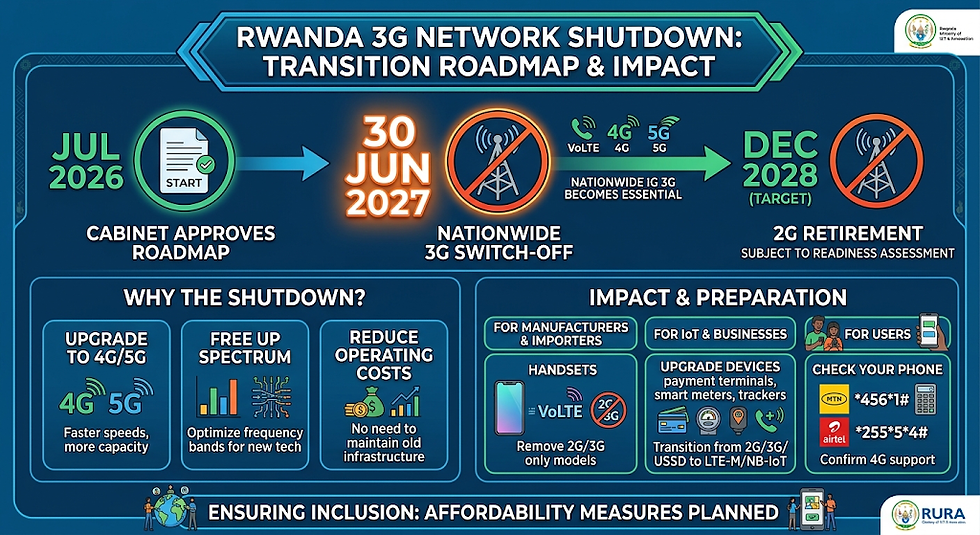
The Government of Rwanda has approved a phased roadmap to retire the country's legacy 2G and 3G mobile networks and complete the national transition to 4G and 5G. In a statement published by the Ministry of ICT and Innovation (MINICT), the government confirmed that 3G services will be switched off nationwide on 30 June 2027, with the 2G network to be retired at a later stage.
For device manufacturers, importers and test labs, this is a market signalling event rather than a change to Rwanda's equipment authorization rules. It does not, on its own, amend the type approval regime administered by the Rwanda Utilities Regulatory Authority (RURA). It does, however, set a firm national deadline after which 3G dependent products will lose their supporting network and it puts every 2G/3G only handset, module and connected device on a defined path to obsolescence in the Rwandan market.
What the roadmap actually says
The transition is being coordinated by MINICT and RURA together with mobile network operators, through a working group that also includes government institutions and the financial sector. According to the primary MINICT statement, the key parameters are:
3G nationwide switch off: 30 June 2027 a firm target, contingent on defined readiness conditions being met.
2G retirement: the government is "currently working towards December 2028." This date is not presented as final; it depends on the outcome of the 3G transition and a readiness assessment covering network coverage, service continuity, the number of people still using older phones, and the migration of systems that depend on 2G. Treat December 2028 as provisional until confirmed in a subsequent instrument.
Rationale: running four generations of mobile technology simultaneously is costly, consumes valuable spectrum, and limits investment in newer networks. Retiring 2G and 3G frees spectrum for 4G and 5G.
Inclusion concern: a study conducted for Rwanda found that, without a planned transition, more than two million people could still be using 2G in 2030 many unable to afford a 4G capable phone. The plan includes affordability measures so users are not disconnected.
Why the Rwanda 3G network shutdown matters for equipment authorization
Although the roadmap is a policy instrument and not a type approval rule, it changes the commercial and technical baseline that certification decisions rest on. From the primary statement, three requirements stand out for anyone placing wireless devices on the Rwandan market:
VoLTE becomes effectively essential for voice. MINICT explicitly lists the availability and reliability of Voice over LTE (VoLTE), including for emergency calls, as a readiness condition for the 3G switch off. Handsets that fall back to 3G/2G for voice will not be viable once those layers are gone.
2G/3G only devices lose their market. Consumers are advised to avoid buying phones that support only 2G or 3G. There is no announced import ban or certification restriction on such devices, but their addressable lifespan in Rwanda is now capped by the switch off dates.
Legacy IoT/M2M is directly in scope. The government names USSD services, card and payment terminals, utility meters, security systems and vehicle trackers as connected equipment that must be migrated. Modules certified for 2G/3G only connectivity will need re design or replacement.
What this means for manufacturers
If you sell, import or certify wireless products for Rwanda, the practical takeaways are:
Handset portfolios: ensure 4G and above devices intended for Rwanda support VoLTE (with emergency call support). Phase 2G/3G only SKUs out of the Rwandan roadmap. Cat-1/Cat-1 bis or higher LTE is the safe floor for new voice-capable products.
IoT and M2M modules: audit any product line that relies on 2G/3G or USSD bearers smart meters, trackers, alarms, POS/mPOS, telematics. Plan LTE-M/NB-IoT or LTE migration now; the 3G date is under three years out and 2G is on a defined exit path.
Type approval: RURA remains the equipment authorization authority. The roadmap does not currently change RURA's technical requirements or the type approval submission process, but manufacturers should watch for follow on RURA guidance aimed at legacy only devices as the switch off approaches.
Documentation and labelling: where operators or RURA issue transition guidance, keep device datasheets and declared radio capabilities (supported bands, VoLTE, IMS) current, as these become the basis for "will this still work after 2027?" queries from importers and retailers.
No open ended exemptions: MINICT states that a limited number of critical services may receive temporary extra time, approved by the regulator with a clear migration plan but there will be no permanent exemptions. Do not build commercial plans around indefinite 3G availability.
Certification impact summary
Area | Current position | Change under the roadmap | Action trigger |
RURA type approval (regime) | RURA is Rwanda's equipment authorization authority | No announced change to type approval rules or process | Monitor RURA for follow on guidance |
Voice capable handsets | 2G/3G fallback still functional today | VoLTE required; 3G voice ends 30 Jun 2027 | Confirm VoLTE + emergency call support on Rwanda SKUs |
2G/3G only handsets | Sold and usable | Lose network from switch off dates; no import ban announced | Remove from Rwanda roadmap |
IoT/M2M modules (2G/3G/USSD) | Widely deployed (meters, trackers, POS, alarms) | Must migrate to LTE-M/NB-IoT/LTE | Begin re design/replacement planning now |
5G / 4G devices | Supported and expanding | Prioritised; spectrum reallocated to 4G/5G | Standard RURA type approval |
Timeline and required actions
Date / window | Milestone (per MINICT) | Required manufacturer/importer action |
24–28 Jul 2026 | Cabinet briefed (24 Jul); MINICT statement published (28 Jul) | Note the roadmap; begin portfolio review |
Through 2026 | 4G expansion; VoLTE reliability confirmed; trial 3G shutdowns in selected areas; legacy services/devices identified | Audit 2G/3G-dependent SKUs and IoT lines; start migration design |
H1 2027 | Migration of critical systems completed; customer notifications; joint response team established; more frequent monitoring | Finalise LTE/VoLTE product transitions; align import stock |
30 Jun 2027 | Nationwide 3G switch-off | Ensure no 3G-dependent products remain in the Rwanda channel |
Dec 2028 | Targeted 2G retirement, subject to readiness assessment | Complete 2G IoT/M2M migration; retire 2G-only SKUs |
How users and businesses can check readiness
The MINICT statement advises phone users to confirm 4G support and follow operator guidance. SIM compatibility check codes published by the ministry are: MTN 4561# and Airtel 2555*4#. Businesses and institutions are asked to identify equipment relying on 2G/3G (USSD, payment terminals, meters, security systems, trackers), assign transition ownership, budget for replacement, and confirm continuity before 30 June 2027.
