Panama PNAF Update: 6 GHz, Direct-to-Cell and FWA Changes
Panama PNAF Update: ASEP Consults on Unlicensed Lower 6 GHz, Direct-to-Cell Rules, the FWA Canal Area and ITU RR-2024 Alignment
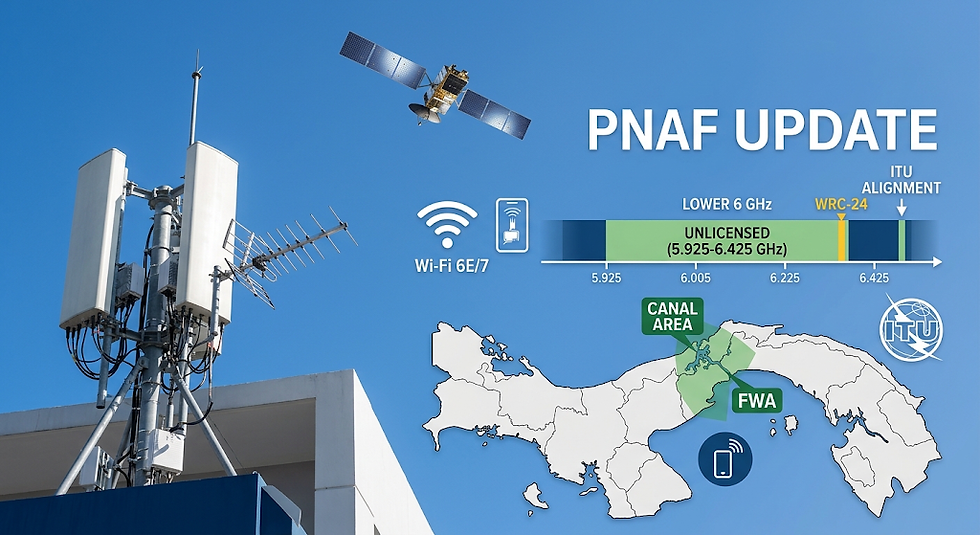
Panama's National Public Services Authority (Autoridad Nacional de los Servicios Públicos, ASEP) has opened Public Consultation No. 012-26 on proposed modifications to the National Frequency Allocation Plan (Plan Nacional de Atribución de Frecuencias, PNAF). This Panama PNAF update has four parts: opening the lower 6 GHz band to unlicensed use, regulating satellite Direct-to-Cell (D2C) services, redefining the Canal Area used for Fixed Wireless Access (FWA) assignments, and aligning the national allocation table with the 2024 edition of the ITU Radio Regulations.
Written comments are accepted from September 28, 2026, at 8:30 a.m. until October 28, 2026, at 3:30 p.m. The measures are proposals. Nothing changes for products on the Panamanian market until ASEP adopts a final resolution.
Why ASEP is revising the PNAF
The PNAF divides Panama's radio spectrum into segments and defines the services allowed in each. Under Law No. 31 of February 8, 1996, ASEP must keep the plan current with international treaties and with new technologies. In the consultation document, ASEP points to three developments behind this review: newer generations of Wi-Fi, low Earth orbit satellite systems, and direct satellite connectivity to ordinary mobile devices.
The 6 GHz question has been open for some time. In Public Consultation No. 011-24, ASEP proposed designating the full 5,925–7,125 MHz range for unlicensed use. Resolution AN No. 20335-Telco of May 5, 2025, left the band unchanged and deferred the matter to a later consultation. ASEP then held Public Forum No. 01-26 on July 7, 2026, and the current proposal is the result.
What the Panama PNAF update proposes
# | Topic | PNAF provision | Proposed change |
1 | ITU alignment | Article 14.8 | Update the National Frequency Allocation Table to the ITU Radio Regulations (RR-2024), including decisions of WRC-23 |
2 | Lower 6 GHz | New numeral 12.8 | Designate 5.925–6.425 GHz (500 MHz) as a "free use or unlicensed" band for low-power devices |
3 | Fixed Wireless Access | Numeral 22.1.3 | Redefine the "Canal Area" assignment zone to match the Canal Operation Compatibility Area in Law No. 21 of July 2, 1997 |
4 | Direct-to-Cell | New numeral 8.5 | Set conditions for D2C service in Mobile Satellite Service bands, including terminal homologation |
1. Alignment with ITU RR-2024
ASEP proposes revising 29 segments of the allocation table, from HF broadcasting at 7,300 kHz up to 248 GHz. Many of the segments involve satellite allocations, including Mobile Satellite Service ranges in the L-band (around 1.5 and 1.6 GHz) and Fixed Satellite Service ranges in the Ku and Ka bands. The exact edits are marked in the consultation document and should be reviewed there by any company whose products or networks rely on a specific allocation.
2. Lower 6 GHz band for unlicensed use
This is the part with the most direct effect on equipment makers. ASEP states that Wi-Fi 6E devices cannot currently be homologated in Panama, because operation in this segment is not permitted. The proposal would change that for 5.925–6.425 GHz, using the technical parameters of CITEL Recommendation CCP.II/REC.70 (XLIV-24).
Two device classes are proposed:
Class | Where | Device type | Max EIRP | Max EIRP density | Out-of-band limit |
LPI (low power indoor) | Indoor only | Access point or subordinate device | 30 dBm | 5 dBm/MHz | −27 dBm/MHz |
LPI (low power indoor) | Indoor only | Client device | 24 dBm | −1 dBm/MHz | −27 dBm/MHz |
VLP (very low power) | Indoor and outdoor | User terminal | 14 dBm | −5 dBm/MHz | −27 dBm/MHz |
Operating restrictions in the draft text:
LPI access points and subordinate devices must use an integrated antenna and mains power. Battery-only operation and weatherproof enclosures are not allowed.
LPI devices may not be used in cars, trains or vessels, or for unmanned aircraft communications. Use aboard large aircraft flying above 10,000 feet is the stated exception.
VLP devices must use integrated antennas, may not be installed on buildings, poles, towers or other fixed outdoor structures, and must prioritize frequencies above 6.105 GHz before using 5.925–6.105 GHz.
All devices operate on a non-interference, non-protected basis.
Existing fixed and satellite assignments in the band are not affected. The upper segment, 6.425–7.125 GHz, is left for a second phase. ASEP says it wants more technical and regulatory input first, including the outcome of the World Radiocommunication Conference in 2027 (WRC-27). Standard-power operation and Automated Frequency Coordination are not part of this proposal.
3. FWA: a new definition of the Canal Area
FWA frequencies are assigned by geographic zone. Today the Canal Area is described only by reference to the Pacific locks (Cocolí and Miraflores) and the Atlantic locks (Gatún and Agua Clara). ASEP proposes defining it by the Canal Operation Compatibility Area in Law No. 21 of 1997, at the request of the Panama Canal Authority (ACP).
The 3,600–3,640 MHz reservation for the ACP stays in place. Assignments across 3,600–3,700 MHz would be allowed, by exception, along the maritime transit route between the locks. ASEP states that the change does not alter existing assignments, technical conditions or rights already granted.
4. Direct-to-Cell in Mobile Satellite Service bands
The proposed numeral 8.5 defines D2C as direct communication between satellites and conventional user terminals such as mobile phones and tablets. IoT terminals such as industrial sensors and trackers are excluded from the definition.
Main conditions for satellite concessionaires (Services No. 217 and No. 222):
The user terminal may access the satellite frequencies only where terrestrial mobile service (Services No. 106 and No. 107) is absent.
Spectrum is capped at 10 MHz Earth-to-space plus 10 MHz space-to-Earth (2 x 10 MHz).
An agreement with a mobile operator covering technical parameters, service quality and responsibilities is to be filed with ASEP for review.
The concessionaire must resolve harmful interference immediately, including by reducing power, reconfiguring beams or suspending emissions.
Terminals intended for D2C must comply with ASEP's Wireless Device Homologation Procedure for the Mobile Satellite Service bands, before commercial service begins.
The proposal follows two recent decisions. Resolution AN No. 22018-Telco of August 25, 2026, temporarily suspended the processing of new D2C applications in these bands. Resolution AN No. 22088-Telco of September 11, 2026, authorized Cable & Wireless Panama to offer commercial D2C in the AWS band over Starlink's network, under the existing numeral 8.4.
What this means for manufacturers
Wi-Fi 6E and Wi-Fi 7 products gain a route to market. If adopted, numeral 12.8 would let indoor access points, client devices and VLP portables operating in 5.925–6.425 GHz enter ASEP's homologation process for the first time.
Panama would be a lower-band-only market. Products certified elsewhere for the full 5.925–7.125 GHz range will need a country configuration that keeps operation within the lower 500 MHz and within Panama's EIRP and density limits.
Design rules matter as much as power limits. Integrated antennas, mains power and non-weatherproof housings are conditions for LPI access points. Outdoor access points and devices with external antennas fall outside the proposal.
D2C adds a homologation step for handsets and tablets. A device marketed for satellite service in MSS bands would need those bands covered in its Panamanian approval before the operator launches the service.
FWA equipment is largely unaffected. The change concerns where frequencies are assigned, not how customer premises equipment must perform.
Some details are still open. The consultation document does not say which test reports or standards ASEP will accept for 6 GHz, nor whether existing approvals can be extended to add the band. These are reasonable points to raise in written comments.
Certification impact summary
Product category | Position today | If the proposal is adopted | Certification impact |
Indoor Wi-Fi 6E / Wi-Fi 7 access points, routers, mesh nodes | 6 GHz operation cannot be homologated | Allowed as LPI, indoor only, 30 dBm EIRP, 5 dBm/MHz | High: new or updated ASEP homologation covering 5.925–6.425 GHz |
Client devices (phones, laptops, tablets) | 6 GHz operation cannot be homologated | Allowed as LPI clients, 24 dBm EIRP, −1 dBm/MHz | High: 6 GHz can be enabled once covered by homologation |
Portable VLP devices | Not permitted | Allowed indoors and outdoors, 14 dBm EIRP, −5 dBm/MHz | Medium: new device class, integrated antenna required |
Outdoor or standard-power 6 GHz equipment, external antennas | Not permitted | Still not permitted | None: remains outside the framework |
Devices using 6.425–7.125 GHz | Not permitted | Still not permitted, second phase | None for now: restrict operation to the lower band |
D2C-capable phones and tablets (MSS bands) | No dedicated PNAF rule | Homologation for MSS bands required before commercial launch | Medium to high: confirm band coverage in approvals |
IoT satellite terminals | Outside the D2C definition | Still outside the D2C definition | No change from this proposal |
FWA customer equipment, 3.6 GHz | Assigned by zone | Canal Area boundary redefined | Low: no change to technical conditions |
Timeline and required actions
Date | Milestone | Status |
May 5, 2025 | Resolution AN No. 20335-Telco leaves 6 GHz unchanged pending further study | Completed |
July 7, 2026 | ASEP Public Forum No. 01-26 on the 6 GHz band | Completed |
August 25, 2026 | Resolution AN No. 22018-Telco suspends new D2C applications in MSS bands | In force |
September 22, 2026 | Notice ANAT-034-26 convenes Public Consultation No. 012-26 | Published |
September 28, 2026, 8:30 a.m. | Comment period opens | Open |
October 28, 2026, 3:30 p.m. | Comment period closes | Deadline |
After closing | ASEP publishes the closing record and comments, then issues its resolution | No date announced |
2027 | WRC-27, cited by ASEP as input for the upper 6 GHz decision | Pending |
ASEP has not committed to a decision date. For reference, the previous PNAF consultation closed on October 31, 2024, and its resolution was issued on May 5, 2025, about six months later.
Required actions
Now to October 28, 2026: Review the consultation document and decide whether to file comments, directly or through an industry association. Follow the submission instructions in Notice ANAT-034-26.
Now: Map the product portfolio against the proposed LPI and VLP limits. Identify models that need a Panama-specific 6 GHz configuration.
Now: Check design conditions for access points: integrated antenna, mains power, no weatherproof enclosure.
Before the final resolution: Gather 6 GHz test reports and technical files so that homologation applications can be filed promptly after adoption.
Until adoption: Keep 6 GHz operation disabled in products shipped to Panama. The band is not yet authorized.
D2C handset makers and satellite operators: Confirm which MSS bands each device supports and plan the homologation step ahead of any commercial launch.
After closing: Monitor ASEP for the closing record, the published comments and the final resolution, and for any follow-up consultation on 6.425–7.125 GHz.
