NICTA 6 GHz Consultation: Papua New Guinea Wi-Fi 6E Rules
Papua New Guinea: NICTA 6 GHz Consultation on Wi-Fi 6E WAS/RLAN Rules and the Draft LIPD Class Licence 2026
Papua New Guinea has taken its first concrete step toward licence-exempt Wi-Fi 6E. On 25 June 2026, the National Information and Communications Technology Authority (NICTA) opened a public consultation on two draft instruments that together would open the lower 6 GHz band to Wireless Access Systems / Radio Local Area Networks (WAS/RLAN) and, in the same stroke, replace the entire framework governing short-range devices in the country.
The comment period closed on 10 July 2026 at 5:00 pm. Submissions and NICTA's report are both listed as pending. Neither instrument is in force, and manufacturers should treat every figure below as a draft parameter subject to change.
The second instrument is the one that deserves attention beyond the Wi-Fi headline. It is not a set of "requirements under" an existing class licence it is a new class licence, and it revokes the one PNG has operated under since 2016.
What the NICTA 6 GHz Consultation Actually Proposes
Two documents were released for comment:
1. Draft Guideline on the Operation of WAS/RLAN in the 6 GHz Band (Document Ref. 2026.1, first draft, June 2026). This sets the regulatory, technical and operational framework for Wi-Fi 6E/7 systems.
2. Radiocommunications (Low Interference Potential Devices) Class Licence 2026 (revision dated 19 May 2026). Made under Section 176 of the National ICT Act 2009, this instrument revokes the Radiocommunications (LIPD) Class Licence 2016 and replaces it in full. It commences on gazettal.
Lower 6 GHz only the upper band stays closed
The most important scope point, and the one most likely to be misread: NICTA is not opening the full 1200 MHz of 6 GHz spectrum.
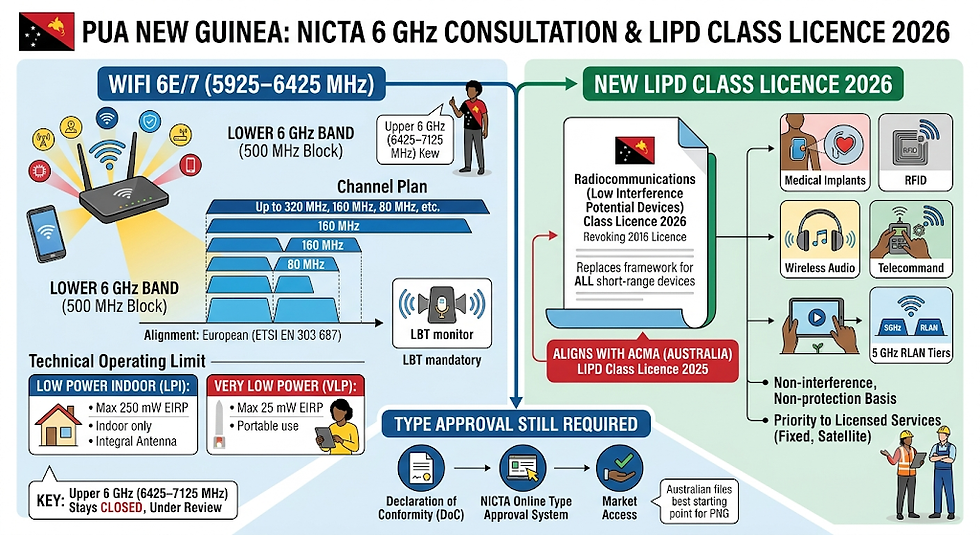
The draft Guideline makes available 5925–6425 MHz only a contiguous 500 MHz block, the "lower 6 GHz." The upper 6 GHz band (6425–7125 MHz) remains under review. NICTA states it will take a technology neutral approach and continue monitoring ITU-R studies, APT developments and WRC-27 outcomes before deciding the band's long-term use. Some administrations have identified portions of the upper band for IMT; NICTA is not committing either way.
This matters because the band is not empty. PNG's Table of Frequency Allocations gives Fixed, Fixed-Satellite and Mobile services primary status across 6 GHz, and the band carries VSAT uplink in 5925–6725 MHz, alongside fixed point-to-point microwave links. Wi-Fi will be sharing.
Channel plan
Within 5925–6425 MHz, the draft supports up to 25 × 20 MHz, 12 × 40 MHz, 6 × 80 MHz, 3 × 160 MHz, or 1 × 320 MHz channels. The channelling arrangement is built on IEEE 802.11ax (Wi-Fi 6E), IEEE 802.11be (Wi-Fi 7), ETSI EN 303 687, ECC Decision (20)01, and Wi-Fi Alliance specifications an unambiguously European alignment.
Technical operating limits
Two device categories are proposed, with limits specified at Item 63A of Schedule 1 to the draft LIPD Class Licence 2026:
Operational category | Max EIRP | Max PSD | Permitted environment |
Low Power Indoor (LPI) | 250 mW (24 dBm) | 12.5 mW/MHz | Indoor only |
Very Low Power (VLP) | 25 mW (14 dBm) | 1.25 mW/MHz | Portable use |
Additional conditions attach to both:
Contention-based protocol (listen-before-talk / clear channel assessment) is mandatory for both LPI and VLP.
Out-of-band emissions below 5925 MHz: not to exceed −27 dBm EIRP per 1 MHz for LPI, and −37 dBm EIRP per 1 MHz for VLP.
LPI devices must use integrated antennas, operate indoors only, and must not be operated on aircraft, vessels, vehicles or unmanned aerial systems unless separately authorised by NICTA.
Both categories must comply with ETSI EN 303 687 (Schedule 2, item 18).
Note the absence of any standard-power / AFC category. There is no Automated Frequency Coordination regime in the draft a deliberate simplification that matches the EU model rather than the US or Canadian one.
Licensing basis
Wi-Fi 6E/7 equipment would operate under a class licence (licence-exempt) framework on a non-interference, non-protection basis. Users cannot claim protection from interference caused by licensed services. Licensed incumbents retain priority, and NICTA reserves the power to require modification, relocation, power reduction, suspension or cessation of operation where harmful interference is identified.
The LIPD Class Licence 2026 Is the Bigger Story
The Wi-Fi 6E entry is a single line item, 63A, in a document that rewrites every short-range device category in Papua New Guinea.
And the sourcing is explicit. The draft states that NICTA adopts the Australian Communications and Media Authority's Radiocommunications (Low Interference Potential Devices) Class Licence 2025, with minor textual changes to align it with existing NICTA regulations.
For manufacturers, that is the single most useful fact in the consultation. If your product already holds a compliant position under the ACMA LIPD Class Licence, you are most of the way to compliance in PNG. The schedules track Australia's closely non-specific SRDs, wireless audio and microphones, medical implant and telemetry transmitters, RFID, telecommand, frequency-hopping and digital modulation transmitters, UWB, radiodetermination, and the 5 GHz RLAN tiers.
Representative parameters from Schedule 1:
Device class | Band | Max EIRP | Key conditions |
RLAN (Wi-Fi 6E/7) — LPI | 5925–6425 MHz | 250 mW | Indoor, integral antenna, LBT |
RLAN (Wi-Fi 6E/7) — VLP | 5925–6425 MHz | 25 mW | LBT, PSD 1.25 mW/MHz |
RLAN | 5150–5250 MHz | 200 mW | Indoor only |
RLAN | 5250–5350 MHz | 200 mW | Indoor, DFS; TPC above 100 mW |
RLAN | 5470–5600, 5650–5725 MHz | 1 W | DFS; TPC above 500 mW |
Digital modulation | 2400–2483.5 MHz | 4 W | PSD ≤ 25 mW/3 kHz; ≥500 kHz 6 dB BW |
RFID | 920–926 MHz | 4 W | ISO/IEC 18000-6c; OOB limits apply |
Non-specific | 2400–2483.5 MHz | 10 mW | — |
Non-specific | 433.05–434.79 MHz | 25 mW | — |
UWB | 3400–4800, 6000–8500 MHz | Per standard | EN 302 065 or EN 302 500; no aircraft |
The 5600–5650 MHz segment is excluded from the 5 GHz RLAN allocation reserved for ground-based meteorological radar.
Compliance mechanics
The class licence authorises operation without an application or licence fee. But it does not remove type approval. To place LIPD/SRD product on the PNG market, the draft requires:
A Declaration of Conformity (DoC) submitted to NICTA; and
A Type Approval Application Form with supporting product test information, filed through the NICTA Online Type Approval System.
EMF compliance is assessed against the NICTA EMF Exposure Limit Guideline 2018, with the ARPANSA standard referenced for integral-antenna devices.
What This Means for Manufacturers
Wi-Fi 6E/7 device makers. PNG is heading toward an EU-style lower 6 GHz regime. If your 6 GHz radio is already certified to ETSI EN 303 687 with LPI and VLP modes at EU power levels, you are aligned. What you must confirm is that firmware can restrict operation to 5925–6425 MHz and disable the upper band a device configured for the FCC's full 5925–7125 MHz range would be non-compliant in PNG.
Devices relying on standard-power / AFC operation have no pathway here.
Short-range device makers generally. Do not read this as a Wi-Fi-only development. The LIPD Class Licence 2026 revokes the 2016 instrument outright. Every SRD you currently sell into PNG under the 2016 class licence will, on gazettal, be governed by a new schedule. Most parameters will be familiar if you track ACMA — but "most" is doing real work in that sentence. Re-check your bands and EIRP against Schedule 1 line by line.
Australian market products get a shortcut. The explicit adoption of the ACMA 2025 class licence means an existing Australian compliance file is the strongest possible starting point for PNG. This is the most efficient route to market access, and it is worth building your PNG dossier off the Australian one rather than the European or US file.
Type approval is unchanged in principle. Licence-exempt does not mean approval-exempt. DoC plus type approval through the NICTA online system remains mandatory.
Certification Impact Summary
Area | Current position | Proposed change | Impact |
6 GHz WAS/RLAN | Not permitted | 5925–6425 MHz licence-exempt (LPI/VLP) | New market access for Wi-Fi 6E/7 |
Upper 6 GHz (6425–7125 MHz) | Not available | Remains under review pending WRC-27 | No change — do not plan for it |
LIPD/SRD framework | LIPD Class Licence 2016 | Revoked; replaced by LIPD Class Licence 2026 | Full re-baseline of all SRD categories |
Reference standard (6 GHz) | — | ETSI EN 303 687 | EU test reports become directly usable |
Regulatory alignment | Mixed | ACMA LIPD Class Licence 2025 adopted | Australian files become the best starting point |
Standard-power / AFC | Not available | Not proposed | No AFC pathway in PNG |
Type approval | DoC + NICTA TA Online | Unchanged | Existing process continues |
Legal status | — | Draft; commences on gazettal | Nothing in force yet |
Timeline and Required Actions
Date | Event | Status |
19 May 2026 | LIPD Class Licence 2026 draft revision dated | Complete |
25 June 2026 | NICTA publishes both drafts; consultation opens | Complete |
10 July 2026, 5:00 pm | Comment deadline | Closed |
Pending | Submissions published | Awaiting NICTA |
Pending | NICTA consultation report | Awaiting NICTA |
TBD | Gazettal of LIPD Class Licence 2026 | Commencement trigger |
Required actions for manufacturers and importers:
Monitor gazettal. The LIPD Class Licence 2026 commences on gazettal, not on publication of the final text. Track NICTA's Gazettes and Public Notices.
Audit your SRD portfolio against Schedule 1 of the draft class licence. Identify any product whose band or EIRP sits outside the new schedule.
Confirm 6 GHz firmware band-limiting. Verify that Wi-Fi 6E/7 products can be restricted to 5925–6425 MHz for the PNG SKU, with LPI/VLP power and PSD limits enforced.
Pull your ACMA compliance file. If the product is certified under the Australian LIPD class licence, that documentation is the most direct basis for a PNG submission.
Verify ETSI EN 303 687 coverage in your 6 GHz test reports.
Do not market 6 GHz product in PNG yet. The guideline is a draft. Operation is not authorised until the class licence is gazetted.
Watch the adjacent consultation. NICTA has separately called for comments on draft 2.3 GHz and 3.5 GHz band plans for IMT — relevant to anyone tracking PNG spectrum more broadly.
