Mauritius 3G Sunset: ICTA Phase-Out by 2028
Mauritius 3G Sunset: ICTA Confirms Full Phase-Out by 2028
The Information and Communication Technologies Authority (ICTA) of Mauritius has formally confirmed that the country will retire its 3G mobile networks, marking a decisive step in the island nation's migration to modern wireless standards. In a Press Communique issued on 28 May 2026, the regulator announced that Mobile Network Operators (MNOs) have begun decommissioning their 3G infrastructure and that 3G services will not be offered beyond 2028 at the latest. For manufacturers, importers, and regulatory affairs professionals supplying the Mauritian market, the announcement carries clear implications for any product that depends on 3G-only connectivity.
Regulatory Background
ICTA is the national regulator for the ICT sector in Mauritius, operating under the Information and Communication Technologies Act 2001. Its mandate covers licensing, spectrum management, consumer protection, and equipment-related guidance for the telecommunications market.
Mauritius has historically been an early adopter in the region, it was among the first markets in greater Africa to launch commercial 3G service in the mid-2000s. Two decades later, the same network resources are being repurposed to support more spectrally efficient technologies. The Government of Mauritius endorsed the decision to phase out 3G on 3 October 2025, following operational considerations raised by the mobile operators themselves. The 28 May 2026 communique is the public-facing confirmation of that policy and the formal signal to consumers and the supply chain.
Three operators serve the market: Mauritius Telecom (my.t), Emtel, and Mahanagar Telephone Mauritius Ltd (MTML). Each is managing its own decommissioning schedule rather than following a single fixed national switch-off date, with 2028 functioning as the outer boundary for the transition.
Key Provisions of the Mauritius 3G Sunset
The communique sets out several concrete points:
Government endorsement. The decision to phase out 3G was endorsed on 3 October 2025.
Decommissioning underway. MNOs have already initiated the phased shutdown of their 3G networks, each on its own timeline.
Hard outer deadline. 3G mobile services will not be offered beyond 2028.
Purpose. Freeing 3G resources supports the continued roll-out of 4G and 5G, delivering faster and more reliable service.
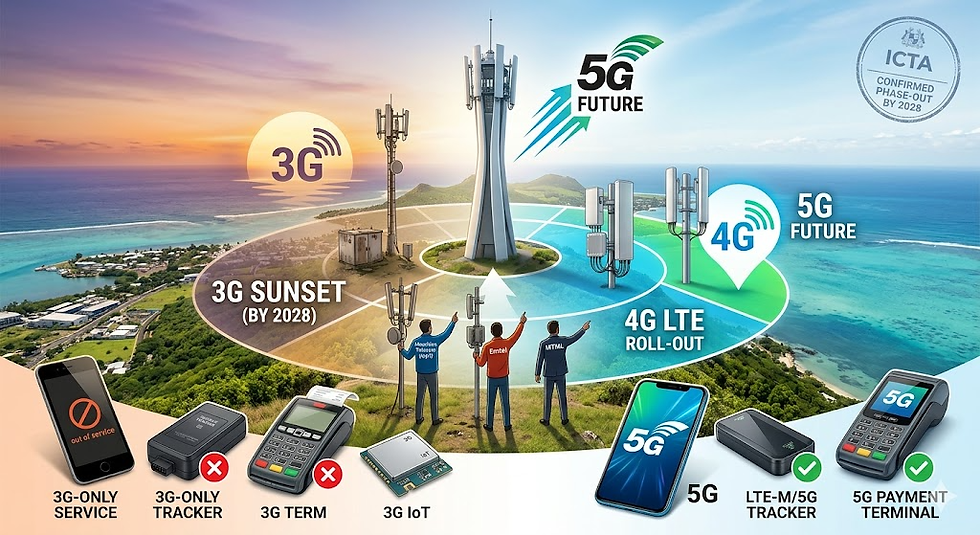
Device impact. Equipment relying solely on 3G — including certain mobile phones, vehicle trackers, and machine-to-machine (M2M) modules — will stop functioning once networks are switched off.
Import guidance. ICTA urges the public to discontinue the importation and use of 3G-only devices and to adopt 4G LTE and 5G-capable equipment.
Operator-led communication. MNOs will run dedicated campaigns and remain the point of contact for operator-specific shutdown timeframes.
What the ICTA 3G Phase-Out Means for Equipment Categories
The regulator's call to stop importing 3G-only devices is particularly relevant beyond consumer handsets. While most subscribers already use 4G or 5G-capable phones, the categories most exposed are embedded and industrial: vehicle trackers, fleet telematics units, alarm and security panels, payment terminals, asset-tracking tags, and a wide range of M2M and IoT modules that were specified years ago around 3G fallback. Any product whose only cellular radio path is 3G (UMTS/HSPA) will lose connectivity in Mauritius once the relevant operator completes its shutdown.
What This Means for Manufacturers
Manufacturers and importers placing cellular enabled products on the Mauritian market should treat the 3G sunset as both a compliance signal and a commercial deadline.
First, product viability. Any device that relies exclusively on 3G for connectivity has a finite functional life in Mauritius. Continuing to ship such products exposes importers to stranded inventory and to selling goods that will cease to operate before the end of their expected service life.
Second, regulatory positioning. ICTA has explicitly discouraged the importation of 3G-only equipment. While the communique is guidance rather than an immediate import prohibition, it signals the regulator's direction of travel. Products submitted for type approval or import clearance going forward should support 4G LTE and/or 5G to remain aligned with national policy and to avoid future market-access friction.
Third, portfolio review. Manufacturers of M2M, IoT, and telematics hardware should audit their Mauritius-bound SKUs for 3G-only variants and prioritize LTE-M, NB-IoT, or LTE Cat-1/Cat-4 replacements. Devices marketed with "3G fallback" as a resilience feature lose that benefit in this market.
Fourth, customer communication. B2B suppliers of fleet, security, and metering solutions should proactively notify Mauritian customers about migration paths, since the end-user impact lands on the deployed device base, not just on new sales.
Certification Impact Summary
Aspect | Status under the Mauritius 3G sunset |
Regulator | Information and Communication Technologies Authority (ICTA) |
Legal basis | Information and Communication Technologies Act 2001 |
Nature of measure | Policy/guidance communique — not an immediate import ban |
New certification scheme introduced | No new approval scheme created by this communique |
Effect on 3G-only devices | Strongly discouraged for import; will lose all connectivity by 2028 |
Recommended device capability | 4G LTE and/or 5G |
Most affected product types | 3G-only handsets, vehicle trackers, M2M/IoT modules, telematics, alarms |
Final network availability | No 3G services beyond 2028 (operator schedules vary) |
Action trigger for importers | Now — phase out 3G-only SKUs from the Mauritius pipeline |
Source verification note: This summary is based on the official ICTA Press Communique dated 28 May 2026. The communique provides guidance on importation and a network-availability deadline; it does not, in itself, establish a new equipment certification or type-approval procedure. Importers should confirm current type-approval and import-clearance requirements directly with ICTA for any specific product.
Timeline and Required Actions
Timeline
3 October 2025 — Government of Mauritius endorses the decision to phase out 3G.
In progress (from 2025/2026) — MNOs begin phased decommissioning of 3G networks, each on its own schedule.
28 May 2026 — ICTA issues the public Press Communique confirming the phase-out and the import guidance.
2026–2028 — Operators run consumer communication campaigns and progressively shut down 3G.
By 2028 (at the latest) — 3G mobile services fully withdrawn in Mauritius.
Required actions for manufacturers and importers
Audit your catalogue for any Mauritius-bound product whose only cellular radio is 3G (UMTS/HSPA).
Stop importing 3G-only devices in line with ICTA's guidance, and clear or redirect existing 3G-only inventory before it becomes unsaleable.
Transition product lines to 4G LTE and/or 5G, including LTE-M and NB-IoT options for IoT and M2M applications.
Confirm type-approval and import-clearance requirements for replacement products directly with ICTA.
Notify deployed customers — particularly in telematics, security, and metering — and provide a documented migration path.
Track operator-specific dates by engaging Mauritius Telecom, Emtel, and MTML, since each shutdown schedule differs.
Market Significance
The Mauritius 3G sunset is part of a broader regional and global wind-down of legacy mobile generations as regulators and operators reallocate spectrum to 4G and 5G. For an early 3G adopter like Mauritius, retiring the technology closes a twenty-year cycle and frees valuable spectrum and network capacity for higher-quality services.
For the supply side, the message is straightforward: 3G-only is now a legacy specification for this market. Manufacturers and importers who move early to 4G LTE and 5G-capable portfolios protect their market access, avoid stranded inventory, and stay aligned with ICTA's stated direction. Those who delay risk shipping products with a connectivity expiry date already on the calendar.
If you supply cellular-enabled equipment to Mauritius and need to confirm how the 3G phase-out affects your specific products or type-approval status, our regulatory team can help you map the impact and plan your transition.


