EU Updates Harmonised Standards for Radio Equipment (2026/2003)
European Union: New Harmonised Standards for Radiodetermination, UWB, and Radio Equipment Under Decision (EU) 2026/2003
Regulatory background
On 4 September 2026, the European Commission adopted Commission Implementing Decision (EU) 2026/2003, published in the Official Journal of the European Union (OJ L, 2026/2003) on 7 September 2026. The Decision amends Implementing Decision (EU) 2022/2191, the instrument that consolidates the harmonised standards conferring a presumption of conformity with the essential requirements of the Radio Equipment Directive (2014/53/EU).
Under Article 16 of Directive 2014/53/EU, radio equipment that complies with a harmonised standard whose reference has been published in the Official Journal is presumed to meet the corresponding essential requirements of the Directive. Harmonised standards themselves are developed by ETSI and Cenelec under a standardisation request issued by the Commission (Implementing Decision C(2015) 5376). Decision 2026/2003 is the latest in a recurring series of updates that keep this reference list current as ETSI and Cenelec revise, replace, or retire individual standards.
The Decision also carries a technical correction to Implementing Decision (EU) 2025/2499 of 9 December 2025, fixing an error in the deletion reference for standard EN 302 729 V2.1.1 (item number "125" is corrected to "121").
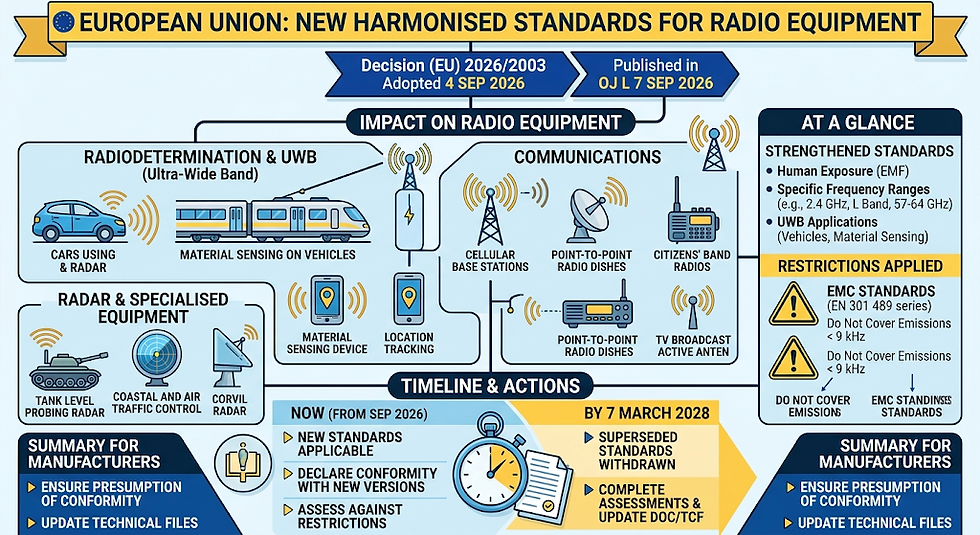
This EU harmonised standards radio equipment update at a glance
The update affects certification pathways for a broad cross-section of radio equipment categories, including:
Radiodetermination equipment for location tracking applications
Cellular communication base stations, repeaters, and ancillary equipment
Ultra-wide band (UWB) devices, including those installed in motor and rail vehicles
Material sensing devices
Fixed point-to-point radio systems
Tank level probing radar (TLPR) equipment
Amplifiers and active antennas for TV broadcast reception
Air traffic control (ATC) primary surveillance radar sensors
Human exposure to electromagnetic fields (wireless device compliance)
Standards newly published or revised (presumption of conformity granted)
Standard reference | Scope |
EN 300 440-2 V3.1.1 | Radiodetermination equipment for location tracking, 2.4–2.4835 GHz |
EN 50566:2017 + A1:2023 + A2:2025 | Human exposure to EMF hand-held and body-mounted wireless devices |
EN 302 217-2 V3.4.1 | Fixed point-to-point radio systems, 1 GHz–174.8 GHz |
EN 302 372 V3.1.1 | Tank Level Probing Radar (UWB), multiple frequency ranges up to 85 GHz |
EN 303 135 V2.2.1 | Coastal surveillance, vessel traffic services, and harbour radars |
EN 303 354 V1.2.1 | Amplifiers and active antennas for domestic TV broadcast reception |
EN 302 065-3-3 V3.1.0 | UWB devices in motor and railway vehicles, 6.0–8.5 GHz |
EN 302 065-4-4 V2.1.1 | UWB exterior material sensing for ground vehicles, below 10.6 GHz |
EN 303 364-1-1 V1.1.1 | Air Traffic Control primary surveillance radar, 1215–1400 MHz (L band) |
EN 305 550-5 V1.1.1 | Ultra Short Range Communication equipment, 57–64 GHz |
EN 301 489-5 V2.3.1 * | EMC — PMR/TETRA ancillary equipment |
EN 301 489-13 V2.1.1 * | EMC — Citizens' Band radio and ancillary equipment |
EN 301 489-50 V2.4.1 * | EMC — cellular base station, repeater, and ancillary equipment |
Standards withdrawn (deferred)
Standard reference | Superseded by |
EN 50566:2017 + A1:2023 | EN 50566:2017 + A1:2023 + A2:2025 |
EN 302 217-2 V3.3.1 | EN 302 217-2 V3.4.1 |
EN 302 372 V2.1.1 | EN 302 372 V3.1.1 |
EN 303 135 V2.1.1 | EN 303 135 V2.2.1 |
EN 303 354 V1.1.1 | EN 303 354 V1.2.1 |
Withdrawal of these five superseded references is deferred to 7 March 2028, giving manufacturers an extended window to complete any necessary design or documentation adaptations before the older versions lose their presumption-of-conformity status.
Certification impact summary
Impact area | Effect |
Presumption of conformity | Extended immediately (7 September 2026) to 13 new/revised harmonised standards |
Restricted standards | 3 EMC standards (EN 301 489-5/-13/-50) confer conformity only within stated limits technical files must document how sub-9 kHz emissions and, for -13, clause 6 criteria are addressed |
Legacy standard validity | 5 superseded standard versions remain usable for conformity purposes only until 7 March 2028 |
Declarations of Conformity (DoC) / Technical Construction Files | Should be updated to cite current standard versions ahead of the 2028 cutoff to avoid a conformity gap |
Notified Body assessments | Products relying on superseded EN 302 217-2, EN 302 372, EN 303 135, EN 303 354, or old EN 50566 references should be re-evaluated against the new versions before the deadline |
Corrective action | No product-level action required for the EN 302 729 correction (Decision 2025/2499) it is an administrative fix to the withdrawal-reference table |
What this means for manufacturers
For manufacturers placing radiodetermination, UWB, fixed radio, cellular base station, or TLPR equipment on the EU market, Decision 2026/2003 is primarily a standards-currency update rather than a new essential-requirements obligation. It does not change the substantive requirements of the Radio Equipment Directive it updates which specific standard versions manufacturers can cite to claim presumption of conformity.
Practical implications:
Equipment already compliant with the outgoing standard versions (EN 302 217-2 V3.3.1, EN 302 372 V2.1.1, EN 303 135 V2.1.1, EN 303 354 V1.1.1, or the earlier EN 50566:2017/A1:2023) remains valid for conformity purposes until 7 March 2028, but should be re-assessed against the new versions well before that date to avoid a last-minute compliance gap.
New product designs for the affected equipment categories should be assessed against the current standard versions from the outset, since the superseded versions will lose their Official Journal reference in 2028.
Manufacturers using the three restricted EN 301 489 EMC standards (-5, -13, -50) should confirm their technical documentation addresses sub-9 kHz emissions separately, and, for CB radio equipment under EN 301 489-13, should not rely on clause 6 for presumption of conformity if it is applied with subjective, non-verifiable criteria.
First-time entrants to categories such as UWB vehicle radiodetermination, air traffic control PSR sensors, or ultra-short-range 57–64 GHz communication equipment now have a clear, currently valid harmonised standard to work against.
Timeline and required actions
Date | Milestone | Recommended action |
7 September 2026 | Decision 2026/2003 enters into force; 13 new/revised standards gain presumption of conformity | Update technical files and DoCs to reference current standard versions for new production |
Ongoing (2026–2028) | Transition window for the 5 superseded standards | Re-test or re-assess affected products against the new standard versions; plan Notified Body engagement where required |
7 March 2028 | Withdrawal of superseded standard references takes effect | Ensure no equipment is placed on the market relying solely on the withdrawn standard versions after this date |

