Chile Updates Short Range Device Regulation 2026
- 19 hours ago
- 5 min read
Chile Updates Short Range Device Regulation: SUBTEL Resolution 966 (2026)
Chile's telecommunications regulator has moved again to modernize the framework governing wireless short range devices (SRDs). On May 27, 2026, the Subsecretaría de Telecomunicaciones + published Exempt Resolution No. 966, amending Exempt Resolution No. 1,985 of 2017, the instrument that fixes the country's Technical Standard for Short Range Devices.
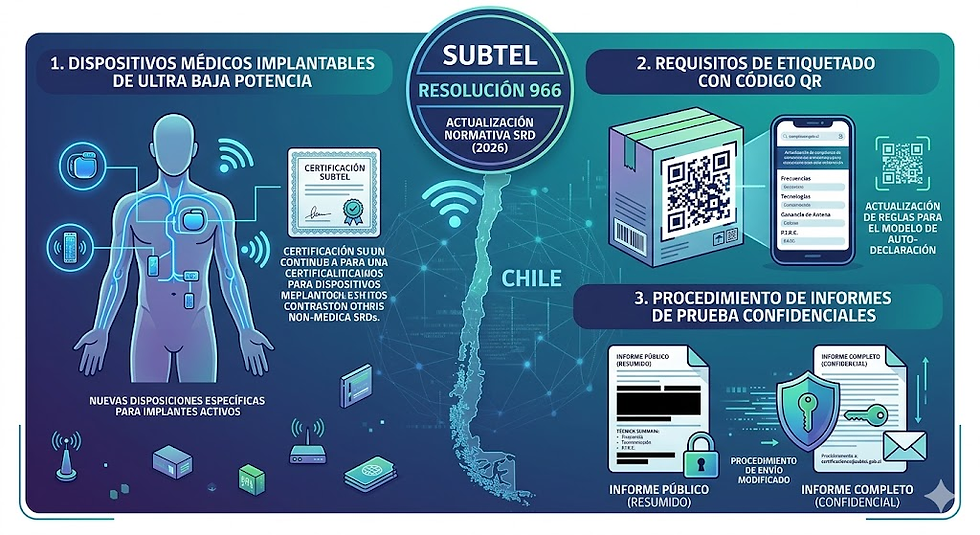
The amendment targets three areas: ultra-low-power active implantable medical devices, QR code labeling requirements, and the procedure for submitting confidential Test Reports. For OEMs, importers, and compliance teams placing wireless products on the Chilean market, the change refines an SRD regime that has been in active transition since 2025.
Regulatory Background
The Technical Standard for Short Range Devices has been Chile's baseline framework for radiocommunication equipment since 2017, defining permitted frequency bands, power limits, and the equipment categories listed in Article 1 of the standard. The framework, defined by Res. Exenta No. 1,985 of 2017, governs documentary verification of compliance for devices that use radio waves and meet the technical requirements set out in the resolution.
The framework was substantially reshaped in 2025. Exempt Resolution 737, published on May 22, 2025, modified Resolution 1,985 to simplify and modernize the certification process for most short range devices, eliminating the mandatory formal SUBTEL certification requirement for non-medical devices and replacing it with a self-declaration model. That regime took effect on February 22, 2026, establishing a compliance approach based on digital QR code labeling and directly affecting manufacturers, importers, and distributors.
Crucially, medical devices were carved out from the simplified path. Implantable medical equipment (MICS) operating in the 402–405 MHz band, medical data acquisition devices in the 430–440 MHz band, and other medical application equipment specified in sections g) and h) of Article 1 continued to require formal SUBTEL certification before commercialization. Resolution 966 builds directly on this structure.
Key Provisions of SUBTEL Resolution 966
Resolution 966 introduces targeted amendments rather than a wholesale overhaul. Based on the published summary, the update addresses:
Provisions for ultra-low-power active implantable medical devices under Chile's short range device regulation
The amendment introduces new provisions specifically for ultra low power active implantable medical devices, a device class that sits within the medical categories (sections g and h) historically subject to formal certification. This reflects the global growth of miniaturized implantable electronics, where power and emission profiles differ markedly from conventional consumer SRDs and warrant dedicated treatment within the technical standard.
Updated QR code labeling requirements
Resolution 966 updates the QR code labeling rules that anchor Chile's self-declaration model. Under the existing framework, regulated SRDs must carry a QR code on the outer packaging linking to a Spanish language compliance page. That page must contain, at minimum, the frequency bands, technologies, antenna gain, and E.I.R.P. values for the device. The amendment refines how these labeling obligations apply.
Modified procedures for confidential Test Report submissions
The amendment also modifies how manufacturers handle confidential Test Reports. SUBTEL's framework already allows a two-tier approach to test documentation. A public-facing Test Report may contain a redacted summary covering at least the declared technical characteristics, while the complete report, including all data gathered by the laboratory, is made available to the authority, with access provided via credentials or a password communicated to SUBTEL by email to certificaciones@subtel.gob.cl. Resolution 966 adjusts the procedural mechanics of this confidential submission pathway.
Collectively, SUBTEL frames these changes as accommodating technological development while easing administrative burdens for manufacturers and importers operating in Chile.
What This Means for Manufacturers
For companies placing wireless products in Chile, the practical takeaways depend on the device category:
Makers of active implantable medical devices should treat this as the highest-priority change. Ultra-low-power implantables now fall under dedicated provisions, and these devices remain in the formally certified track (sections g and h) rather than the self-declaration path. Review your classification and certification documentation against the amended text once published.
Manufacturers and importers of mainstream SRDs (Wi-Fi, Bluetooth, Zigbee, RFID, IoT, UWB) should re-confirm their QR code compliance pages against the updated labeling requirements. Pages that were compliant under the Res. 737 framework may need adjustment.
All regulated parties relying on the confidential Test Report mechanism should review the revised submission procedure to ensure the full report remains accessible to SUBTEL under the new process, and that public redacted versions still meet the minimum disclosure threshold.
Local representation in Chile remains a prerequisite for commercializing regulated equipment, independent of these amendments.
The direction of travel is consistent with Chile's broader shift from ex ante certification toward ex post enforcement for non-medical devices, while keeping a tighter, certification based regime over medical and implantable equipment.
Certification Impact Summary
Area | Before Resolution 966 | After Resolution 966 |
Active implantable medical devices | Covered under general medical categories (g/h); formal certification | Dedicated provisions for ultra-low-power active implantables within the standard |
Certification pathway (medical) | Formal SUBTEL certification (Oficio) required | Formal certification retained; refined for implantables |
Certification pathway (non-medical SRD) | Self-declaration + QR (since Feb 22, 2026) | Unchanged in principle; QR labeling rules refined |
QR code labeling | Spanish compliance page with bands, technologies, antenna gain, E.I.R.P. | Updated labeling requirements |
Confidential Test Reports | Two-tier (public redacted + full to SUBTEL via password) | Modified submission procedure |
Local representation | Required | Required (unchanged) |
Timeline and Required Actions
2017 — SUBTEL fixes the SRD Technical Standard via Res. Exenta No. 1,985.
May 22, 2025 — Res. 737 introduces the self-declaration + QR model for non-medical SRDs.
February 22, 2026 — The QR-based self-declaration regime takes effect.
May 27, 2026 — SUBTEL publishes Res. 966, amending the standard for implantable medical devices, QR labeling, and confidential Test Reports.
Now — Confirm the official consolidated text on SUBTEL's portal and assess applicability to your product portfolio.
Required actions for manufacturers and importers:
Identify whether any products fall within the active implantable medical device class now subject to dedicated provisions.
Review and update QR compliance pages against the amended labeling requirements.
Verify your confidential Test Report submission process aligns with the modified procedure.
Confirm public facing redacted Test Reports still meet minimum disclosure requirements.
Confirm valid local representation in Chile is in place.
Monitor SUBTEL's newsroom and the BCN consolidated text for the official Res. 966 wording.
Market Significance
Chile continues to position itself as one of Latin America's more proactive telecom regulators, balancing market access efficiency for high volume consumer wireless devices against tighter oversight of safety critical medical equipment. Resolution 966's focus on ultra low power active implantables signals that SUBTEL is keeping its technical standard aligned with the medical device innovation curve, an area where regulatory clarity directly affects market entry for advanced healthcare technologies. Manufacturers that treat the amendment as a routine documentation review, rather than waiting for enforcement, will be best positioned to maintain uninterrupted access to the Chilean market.
Source verification note: At the time of writing, the full text of Exempt Resolution No. 966 (May 27, 2026) had not yet been independently indexed online. The provisions summarized here are based on the official announcement and should be confirmed against the consolidated standard published on SUBTEL's portal and in the Diario Oficial before relying on them for compliance decisions.
