Bahamas National Spectrum Plan 2026–2029: WRC-23 Update
On 6 May 2026, the Utilities Regulation and Competition Authority (URCA) published the National Spectrum Plan 2026–2029 under reference ECS 04/2026, together with its Statement of Results and Final Decision closing the public consultation. The Plan is the overarching policy and planning instrument for radio spectrum management in The Bahamas, and it is the fourth iteration in the series following the 2010, 2014 and 2020–2023 editions. Crucially, it is the first to fully incorporate the outcomes of the World Radiocommunication Conference 2023 (WRC-23, Dubai) and the resulting 2024 edition of the ITU Radio Regulations.
Regulatory Context
URCA is the independent regulator for the Electronic Communications Sector (ECS) in The Bahamas and exercises exclusive authority to manage, allocate and assign radio frequencies under Part V (sections 29–38) of the Communications Act 2009. Section 31(4) of that Act requires a revised National Spectrum Plan at least every three years, developed in consultation with the Minister responsible for the ECS and approved under section 31(5).
The revised Plan aligns the national framework with two anchors: domestically, the Electronic Communications Sector Policy 2024–2027, which sets out The Bahamas' digital-transformation and connectivity priorities; and internationally, the ITU Radio Regulations as updated by WRC-23. Written responses to the consultation were received from an anonymous respondent, Cable Bahamas Limited and Be Aliv Limited, the Bahamas Telecommunications Company Limited, and Kuiper Systems LLC, all of which URCA states were considered in reaching its final position.
Technical Scope: What the Bahamas National Spectrum Plan Changes
The most consequential element for equipment makers is the revised National Frequency Allocation Table (NFAT), set out in full in Appendix A and built on the structure of the ITU Radio Regulations for Region 2. URCA has introduced a series of WRC-23-driven amendments:
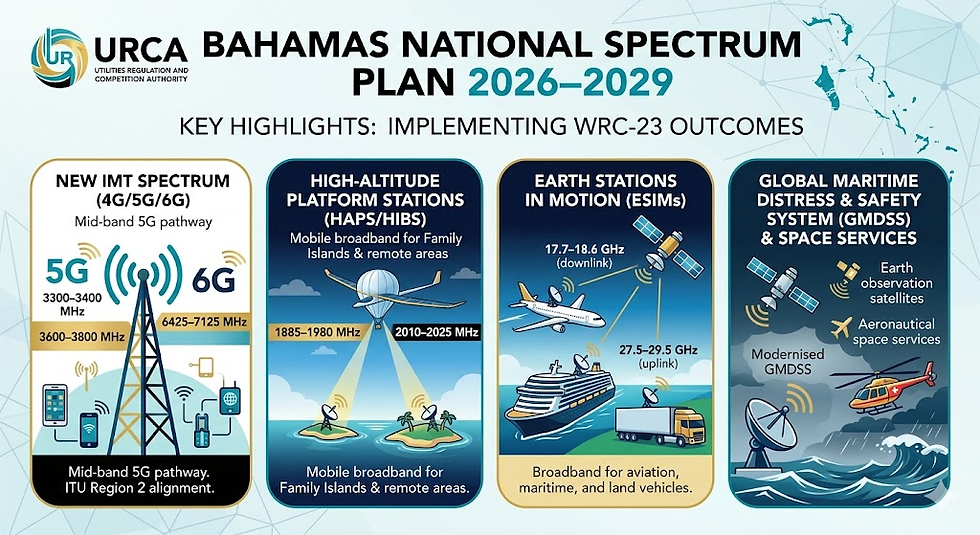
New IMT spectrum (4G/5G/6G)
The Plan identifies new mobile (IMT) capacity to support 4G, 5G and future 6G deployments, including the 3300–3400 MHz, 3600–3800 MHz and 6425–7125 MHz ranges, with the upper 6 GHz band subject to national decision in Region 2. The 3.4–3.7 GHz range is classified as Premium and Standard spectrum, reinforcing its central role in mid-band 5G.
High-Altitude Platform Stations (HAPS/HIBS)
The Plan designates bands for High-Altitude Platform Stations operating as IMT base stations to extend mobile broadband to the Family Islands and remote areas:
1885–1980 MHz (uplink)
2010–2025 MHz (downlink)
2500–2690 MHz (paired/unpaired TDD, as regionally appropriate)
Earth Stations in Motion (ESIMs)
New frequencies support broadband on aircraft, vessels and land vehicles:
17.7–18.6 GHz (downlink)
27.5–29.5 GHz (uplink)
GMDSS and space services
The Plan modernises the Global Maritime Distress and Safety System, including provisional recognition of the BeiDou Satellite Messaging Service subject to further coordination, and adds allocations for Earth observation and aeronautical mobile-satellite services (for example 36–37 GHz and 42.5–43.5 GHz for Earth exploration satellites).
On technical standards, URCA confirms two points that bear directly on product compliance: digital television broadcasting must follow the ATSC standard unless URCA approves an alternative, and the 698–806 MHz range will not be assigned to broadcasting, being reserved for mobile, fixed broadband and public safety.
What This Means for Manufacturers
The Plan is a policy and allocation framework rather than a set of finished device rules, but it sets the direction of travel for type-approval (homologation) in The Bahamas over the next three years. Practical implications:
Mid-band 5G product roadmaps are validated. Equipment targeting 3.3–3.8 GHz and the 6 GHz range now has a clear national allocation pathway, improving harmonisation with ITU Region 2 markets and supporting economies of scale.
Band plans are still pending. URCA states that detailed spectrum band plans (centre frequency, bandwidth, guard bands, spectral masks, modulation) will be developed after publication of the Plan, in separate technical exercises following the ECS 04/2018 procedure. Manufacturers should not assume final channel arrangements yet.
Licence-exempt commercial use is under review. URCA signals a new framework for commercial use of licence-exempt spectrum, potentially introducing technical conditions, registration or fees. Vendors relying on licence-exempt operation for commercial products should monitor this closely.
Type approval remains a URCA function. Granting type approvals sits within URCA's authorisation process, so equipment intended for the Bahamian market will continue to require homologation aligned to the revised NFAT and any forthcoming band plans.
No new SAR or EMC limits are introduced here. The Plan does not set human-exposure or EMI/EMC limits; those continue to flow from existing technical rules and adopted international standards.
Certification Impact Summary
Dimension | Position under NSP 2020–2023 | Position under NSP 2026–2029 (ECS 04/2026) | Manufacturer impact |
ITU reference baseline | ITU-RR through WRC-19 | 2024 ITU-RR, post WRC-23 | Re-baseline band assumptions against Region 2 / WRC-23 |
Mid-band 5G (3.3–3.8 GHz) | Limited / legacy allocations | Identified for IMT; 3.4–3.7 GHz Premium/Standard | Clear pathway for 5G NR mid-band products |
Upper 6 GHz (6425–7125 MHz) | Not identified for IMT | Identified, subject to national decision | Plan ahead for Wi-Fi/IMT coexistence outcomes |
HAPS/HIBS bands | Not designated | 2 GHz and 2.6 GHz designations | New product category opportunity for rural coverage |
ESIM (17.7–18.6 / 27.5–29.5 GHz) | Under satellite review | Identified frequencies | Aero/maritime/land mobile terminals supported |
Band plans (channels, masks) | In force for legacy bands | To be issued post-Plan per ECS 04/2018 | Final technical parameters still pending |
DTV standard | ATSC | ATSC retained (alternatives need approval) | No change for broadcast equipment |
Type approval authority | URCA | URCA (unchanged) | Homologation still required for market access |
Timeline and Required Actions
6 May 2026 — Plan in force. ECS 04/2026 is published and effective following Ministerial approval. Action: download and archive the Plan and the NFAT (Appendix A) as your reference baseline.
Immediately — Re-baseline allocations. Map your product portfolio against the revised NFAT and WRC-23 identifications. Action: flag any SKUs that depend on bands now reclassified or reserved (e.g. 698–806 MHz).
Near term — Monitor band plan development. URCA will issue detailed band plans separately under the ECS 04/2018 process. Action: set alerts on URCA consultations for 3.3–3.8 GHz, 6 GHz, HAPS and ESIM channel arrangements.
Near term — Track licence-exempt framework. A new commercial-use framework for licence-exempt spectrum is anticipated. Action: assess exposure of any commercial products operating in licence-exempt bands.
Ongoing — Maintain type-approval readiness. Action: confirm test reports and homologation files remain consistent with the revised NFAT and any new band plans before submitting to URCA.
Quarterly — Review progress. URCA states implementation progress will be reviewed quarterly. Action: align internal regulatory-watch cycles to URCA's quarterly cadence.
Broader Market Significance
The Bahamas National Spectrum Plan 2026–2029 positions the country firmly within the WRC-23 harmonisation wave that 151 of 193 ITU Member States have endorsed. For manufacturers and EMC test laboratories, the strategic value lies in alignment: by mirroring ITU Region 2 allocations, The Bahamas reduces the friction of bringing globally certified equipment to market and signals predictable demand in mid-band 5G, non-terrestrial networks (HAPS/HIBS) and satellite-connected mobility (ESIM).
The open items pending band plans and the licence exempt commercial use framework are the developments to watch, because they will translate this high-level allocation policy into the concrete channel arrangements and technical conditions that ultimately govern device approval.


