Yemen Import Ban US Israel 2026: Impact on Telecom Certification and Market Access
Yemen Import Ban US Israel 2026: Regulatory Overview
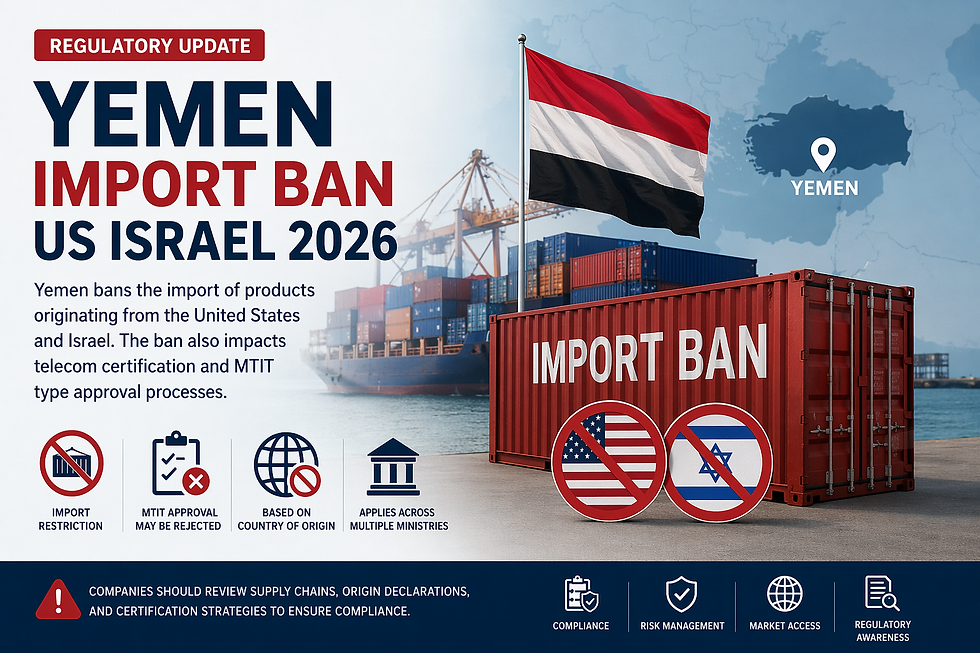
On March 2, 2026, the Yemeni government announced a directive prohibiting the import of products originating from the United States and Israel. This measure represents a significant geopolitical trade restriction with direct implications for regulatory compliance, particularly within the telecommunications sector.
The directive is being enforced across multiple government bodies, including the Ministry of Interior, Ministry of Finance, Ministry of Education, and the Ministry of Telecommunications and Information Technology (MTIT).
Scope of the Regulation
The restriction is strictly based on country of origin (COO). Any product declared as originating from the United States or Israel is prohibited from entering the Yemeni market.
Importantly, this policy is not limited to customs clearance. It extends to regulatory approval processes, including telecom equipment certification managed by MTIT.
Impact on Telecom Certification
The regulation directly affects type approval procedures in Yemen:
Applications declaring US or Israeli origin are subject to rejection
Certification cannot proceed regardless of technical compliance
Both new and pending applications may be impacted
This represents a shift where origin compliance overrides technical certification requirements.
What This Means for Manufacturers
Manufacturers and exporters must urgently reassess their market strategy for Yemen:
Country of origin declarations must be carefully evaluated
Products manufactured in or linked to the US or Israel may lose market access
Supply chains may need restructuring to maintain eligibility
Alternative manufacturing or sourcing strategies may be required
Failure to adapt could result in complete exclusion from the Yemeni market.
Certification Impact Summary
Area | Impact |
Type Approval | Rejection if origin is US/Israel |
Application Status | Pending applications at risk |
Technical Compliance | No longer sufficient alone |
Market Access | Fully restricted based on origin |
Regulatory Risk | High |
Timeline and Required Actions
Timeline
March 2, 2026 → Directive announced
Immediate effect (practical enforcement ongoing)
2026 onward → Strict enforcement across certification and import processes
Required Actions for Companies
Audit product origin documentation
Review current and pending MTIT applications
Assess supply chain dependencies on restricted origins
Consider manufacturing relocation or reclassification strategies
Engage local regulatory experts for compliance validation
Strategic Considerations
This measure reflects a broader trend where geopolitical factors directly influence regulatory frameworks. Companies operating in global telecom markets must integrate trade compliance and certification strategy to mitigate risks.
Conclusion
The Yemen import ban US Israel 2026 introduces a high-impact regulatory barrier that extends beyond traditional certification requirements. By linking market access directly to country of origin, Yemen has effectively redefined compliance conditions for telecom equipment and other imported goods.
Proactive adaptation will be essential for manufacturers aiming to maintain access to the Yemeni market.
