UK 6 GHz Standard Power Wi-Fi: AFC Rules from 10 Nov
UK 6 GHz Standard Power Wi-Fi: Ofcom Licence Exemption for AFC Devices in 5925–7125 MHz from 10 November
UK 6 GHz standard power Wi-Fi will be allowed without a licence from 10 November 2026. The Wireless Telegraphy (Dynamic Spectrum Access Devices) (Exemption) Regulations 2026 (SI 2026/1132) were made on 27 October 2026. They exempt access points and client devices operating across 5925–7125 MHz from the licensing requirement in section 8(1) of the Wireless Telegraphy Act 2006, as long as they work under an automated frequency coordination (AFC) system and meet the conditions in the regulations.
Background
Ofcom has been reviewing the 6 GHz band for some time. In April 2026 it consulted on wider access to the upper 6 GHz band (6425–7125 MHz), which GMA Labs covered at the time. Before making these regulations, Ofcom gave notice of its proposal and considered representations, as the Wireless Telegraphy Act requires. Its regulatory impact assessment is available on its website. The new regulations cover the whole 5925–7125 MHz range for devices that take their operating limits from an AFC system.
Key Changes in the UK 6 GHz Standard Power Wi-Fi Rules
Which devices are covered
A dynamic spectrum access device must operate in 5925–7125 MHz, use the interference mitigation techniques in ETSI EN 303 687 v1.1.1, operate only on land, and be one of three types: a standard power access point, a fixed client device or a mobile client device.
Standard power access points
Access points need geo-location capability and must operate from a fixed location. Within the limits set by the AFC, they can transmit up to 23 dBm/MHz PSD and 36 dBm EIRP, with channels of up to 320 MHz. They pass the AFC parameters on to fixed client devices.
Fixed and mobile client devices
Fixed client devices have the same 23 dBm/MHz and 36 dBm limits and must also stay at a fixed location. Where they get parameters through an access point, a lower fallback of 17 dBm/MHz and 30 dBm applies. Mobile client devices are limited to 17 dBm/MHz and an EIRP at least 6 dB below their access point, capped at 30 dBm. They must stay connected to a standard power access point and can't be used in a moving vehicle. Client devices can't connect to each other.
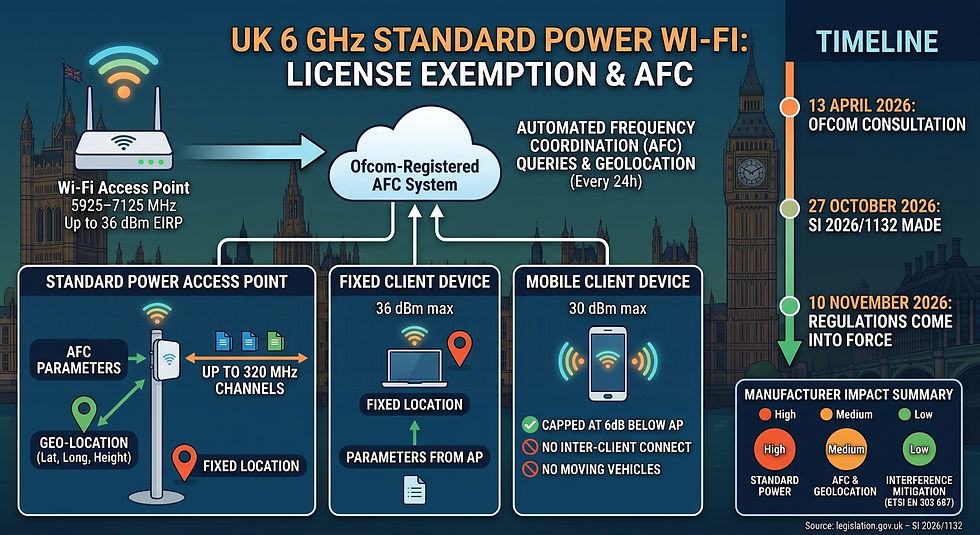
AFC queries and geolocation
Devices must ask the AFC for parameters when powered on and every 24 hours, reporting their location, geo-location uncertainty, antenna height and a unique identifier. If the AFC can't be reached, the last parameters can be used for one more 24-hour period, after which the device must stop transmitting. Users must not be able to change AFC-related settings. AFC systems must be run by organisations registered by Ofcom.
Out-of-band emissions
All devices must meet an emission mask outside the channel, from -20 dB at 1 MHz from the channel edge down to -47 dB further out.
What This Means for Manufacturers
Enterprise and outdoor access points can now be designed for UK standard power operation across the full 6 GHz band.
Products need reliable geo-location, including antenna height and uncertainty, and secure AFC client software that users can't override.
Firmware has to handle the 24-hour re-query and shut down cleanly if the AFC stays unreachable.
Mobile clients need power control that keeps them 6 dB below the access point.
Test plans should cover ETSI EN 303 687 alongside the UK-specific power and AFC conditions.
Whether an Ofcom-registered AFC system is ready by 10 November will decide when deployments can actually start.
Certification Impact Summary
Area | Before | After | Impact level |
Standard power in 5925–7125 MHz | No licence exemption for AFC-controlled standard power | Licence-exempt under SI 2026/1132 | High |
Access point limits | Not applicable | 36 dBm EIRP, 23 dBm/MHz, up to 320 MHz, fixed location | High |
Mobile client limits | Not applicable | 17 dBm/MHz, max 30 dBm, 6 dB below access point | Medium |
AFC and geolocation | Not required | Location reporting, 24-hour re-query, shutdown after AFC loss | High |
Interference mitigation | ETSI EN 303 687 v1.1.1 | ETSI EN 303 687 v1.1.1 | Low |
Other exemption regulations | In force | Not amended by SI 2026/1132 | Low |
Timeline and Required Actions
Key Dates
Date | Milestone |
13 April 2026 | Ofcom consults on wider upper 6 GHz access |
27 October 2026 | SI 2026/1132 made |
10 November 2026 | Regulations come into force |
To be confirmed | First AFC systems registered by Ofcom |
Required Actions for Manufacturers
Decide which access points and client devices you'll offer as UK standard power products.
Check geo-location accuracy, antenna height reporting and AFC client behaviour.
Set power limits by device type: 36 dBm for access points and fixed clients, 30 dBm for mobile clients.
Test the 24-hour re-query and the shutdown after AFC loss.
Confirm conformity with ETSI EN 303 687 v1.1.1 and the out-of-band mask.
Track which AFC operators Ofcom registers.
Conclusion
SI 2026/1132 gives UK 6 GHz standard power Wi-Fi a clear legal basis from 10 November 2026, with firm limits and AFC duties for each device type. Manufacturers that build geolocation and AFC handling into their designs now will be ready once AFC operators are registered. Contact our team for help with UK radio compliance and 6 GHz certification.
