South Korea USB-C KC Certification: Required 6 Nov 2026
South Korea USB-C KC Certification: MSIT Requires USB Type-C Ports on 13 Device Types from 6 November 2026
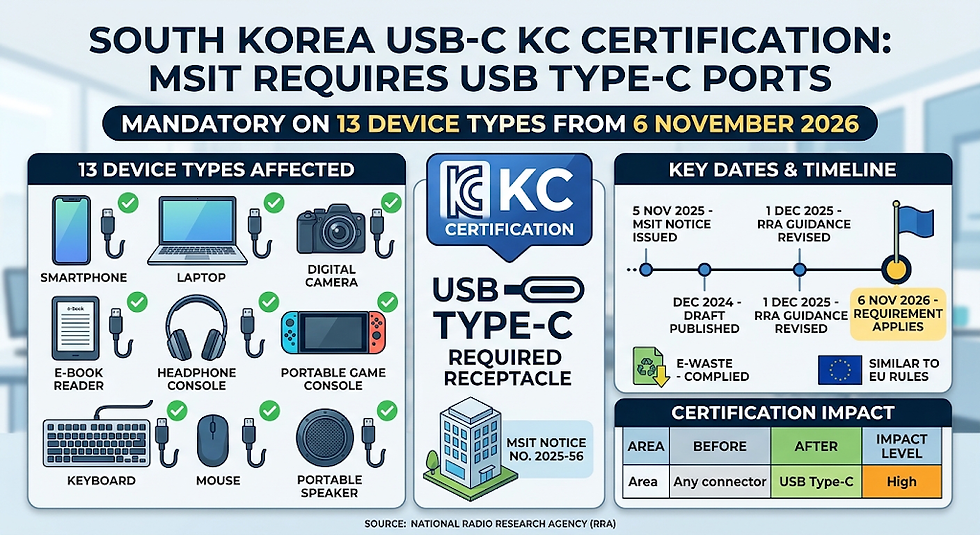
South Korea USB-C KC certification requirements take effect on 6 November 2026. From that date, phones, tablets, laptops and ten other kinds of device that charge through a cable must have a USB Type-C receptacle to get through KC conformity assessment. The rule comes from the Ministry of Science and ICT (MSIT) Notice No. 2025-56, and the National Radio Research Agency (RRA) has published guidance on how it's applied.
Background
MSIT issued Notice No. 2025-56 on 5 November 2025. Its title is the "Technical Standard on Charging and Data Transmission Methods for Broadcasting and Communications Equipment, including Mobile and Smart Devices". MSIT first released it as a draft in December 2024, and the final text gave industry a year before it applies.
The goal is the same one behind the EU's common charger rules: fewer chargers and cables to buy, and less electronic waste. Korea had already adopted USB-C national standards based on the IEC 62680 series in 2022, but those were voluntary. This notice turns the connector into a technical requirement for equipment that goes through KC conformity assessment.
The RRA's guidance, RRA KSDB(S) No. 36-1, sets out which equipment is covered and how to apply. Its contact point is the RRA's ICT Conformity Assessment Division.
Key Changes in the South Korea USB-C KC Certification Rules
The core change is simple. If a covered device charges by cable, or charges and transfers data by cable, the receptacle has to be USB Type-C and meet the connector specification in Annex 1 of the notice.
The 13 device types are:
Mobile phones and tablets
Laptops
Digital cameras
Headphones, headsets and earphones
Portable video game consoles
Portable speakers
E-book readers
Keyboards and mice
Portable navigation devices
Devices that only charge wirelessly don't have a wired receptacle, so the connector rule doesn't bite on them. The list is close to the EU's common charger list, laptops included. The change sits in the connector itself, and it's checked as part of KC conformity assessment.
What This Means for Manufacturers
For most phones and tablets this changes little, because USB-C is already standard. The risk sits with smaller and older products: budget earphones and headsets, keyboards and mice, e-book readers, cameras and portable speakers that still ship with Micro-USB, Lightning or a proprietary charging pin.
Timing matters most. A product that's filed for KC certification on or after 6 November 2026 will be checked against the new standard. If a model with a different port is still in your pipeline, it needs either a redesign or a filing that completes before the date. We haven't seen official guidance on how existing KC certificates are treated, or on any exemptions, so don't assume a grace period.
The agency in Korea can confirm how the RRA is applying the guidance in practice, including which documents the lab or certification body will ask for to show the connector meets Annex 1.
Certification Impact Summary
Area | Before | After | Impact level |
Charging port | Any connector type allowed | USB Type-C receptacle required for wired charging or charging plus data | High |
Products covered | No connector requirement | 13 device types, from phones and laptops to mice and earphones | High |
Legal basis | Voluntary USB-C national standards (2022) | MSIT Notice No. 2025-56, mandatory technical standard | High |
KC assessment | Connector not checked | Connector checked against Annex 1 under RRA guidance KSDB(S) No. 36-1 | Medium |
Existing certificates | Valid under current rules | Treatment not stated in official sources found; to be confirmed | Medium |
Wireless-only devices | Not affected | Not affected by the connector rule | Low |
Timeline and Required Actions
Key Dates
Date | Milestone |
December 2024 | MSIT publishes the draft technical standard |
5 November 2025 | MSIT Notice No. 2025-56 issued |
1 December 2025 | RRA guidance KSDB(S) No. 36-1 revised |
6 November 2026 | USB Type-C receptacle requirement applies |
Required Actions for Manufacturers
List every product you sell in Korea that falls into one of the 13 device types.
Check the charging port on each one, including accessories such as earphones, mice and keyboards.
For any model without USB-C, decide now whether to redesign it or complete its KC filing before 6 November 2026.
Keep connector specifications ready to show compliance with Annex 1.
Ask the agency in Korea how existing certificates and pending applications will be handled.
Update product roadmaps so new Korean launches use USB-C by default.
Conclusion
Korea's USB-C rule is narrow but firm: from 6 November 2026, covered devices that charge by cable need a USB Type-C receptacle to pass KC conformity assessment. Most flagship products are ready, but accessories and older models deserve a quick audit in the next two weeks. Contact our team for support with KC certification and your Korean filings.
