South Africa: ICASA New Approval Platform to Streamline Type Approval (2026)
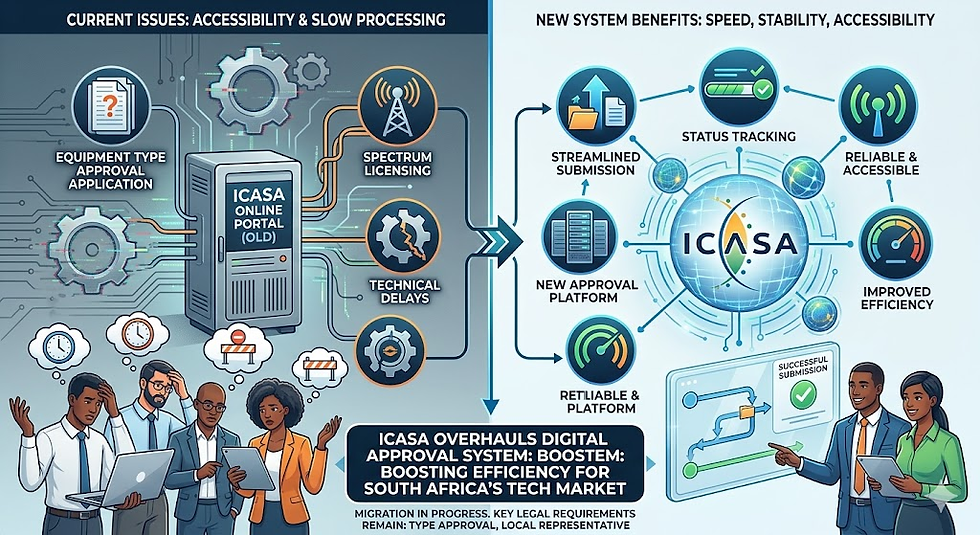
The Independent Communications Authority of South Africa (ICASA) is moving to overhaul the digital system that underpins its equipment approval process. The regulator has been dealing with accessibility issues on its current online project platform, problems that have contributed to slower processing of type approval applications. In response, ICASA intends to build a new approval management platform designed to improve efficiency and reliability. As of now, no official deployment date has been confirmed.
For manufacturers, importers, and distributors that depend on ICASA type approval to bring telecommunications and radio-frequency (RF) equipment into the South African market, this is a development worth tracking closely.
Why the ICASA New Approval Platform Matters
ICASA administers type approval under the Electronic Communications Act (No. 36 of 2005). No telecommunications or RF equipment may be supplied, sold, leased, or used in South Africa unless ICASA has approved it first. Applications are currently submitted through the regulator's online portal (online.icasa.org.za), which handles both spectrum licensing and type approval.
The challenge is that platform reliability directly affects how quickly applications move. When the digital system is difficult to access or unstable, submissions stall, queries pile up, and certification timelines stretch. The planned ICASA new approval platform is intended to address exactly these bottlenecks, reducing friction in submission, tracking, and processing.
What the New Approval Platform Is Expected to Improve
While ICASA has not published full technical specifications, the stated goal is a more efficient approval management system. Realistically, an upgraded platform of this kind would aim to deliver:
More stable and accessible online submission of applications
Clearer status tracking for in-progress applications
Fewer technical interruptions that cause administrative delays
A smoother overall experience for applicants and local representatives
It is important to note that the upgrade is an operational and digital improvement. It does not, on its current description, change the underlying legal requirement for type approval.
What This Means for Manufacturers
For companies placing products into the South African market, the practical takeaways are straightforward:
Type approval remains mandatory. Nothing about this platform change removes the requirement. Devices using RF spectrum or connecting to telecom networks, phones, routers, Bluetooth and Wi-Fi devices, two-way radios, satellite terminals, and similar, still require ICASA approval before import or sale.
A local presence is still required. ICASA issues type approval certificates only to South African–registered companies. Foreign manufacturers without a local entity will still need a South African registered representative.
Timelines may be unpredictable during the transition. A platform migration can temporarily affect how applications are submitted or tracked. Plan launches with buffer time and avoid assuming the fastest-case processing window.
Existing certificates are unaffected. A digital system upgrade does not invalidate approvals already granted.
The net message: keep your compliance pipeline moving as normal, but build in flexibility around scheduling until the new system is live and stable.
Certification Impact Summary
Area | Impact of the platform change |
Legal requirement for type approval | No change — still mandatory under the Electronic Communications Act |
Local representative requirement | No change — still required for foreign manufacturers |
Application submission | Will eventually move to / run on the new platform |
Processing speed | Expected to improve once the new platform is operational |
Existing certificates | Remain valid; not affected by the upgrade |
Launch date of new platform | Not yet officially confirmed by ICASA |
Timeline and Required Actions
Current status (2026): ICASA is constructing a new approval management platform. Applications continue to be processed through the existing online portal. No official launch date has been announced.
What applicants should do now:
Continue submitting through the existing channel. Use the current ICASA online portal (online.icasa.org.za) and do not delay applications while waiting for the new platform.
Confirm your documentation is complete and accurate. Correct product classification and complete paperwork reduce queries and delays which matters even more during a system transition.
Verify your local representation. Ensure your South African registered company or representative details are current.
Build buffer time into product launch plans. Treat processing timelines as variable until the new platform is confirmed live.
Monitor official ICASA channels. Watch the ICASA news page for the deployment announcement and any migration instructions.
Once the new platform launches: Expect possible changes to login, submission steps, or account setup. Be prepared to re-register or re-authenticate, and follow ICASA's official migration guidance when published.


