Canada RSS-310 Issue 6: Key Regulatory Updates
In 2026, Innovation, Science and Economic Development Canada (ISED) introduced Issue 6 of RSS-310, marking a significant update to the regulatory framework governing licence-exempt Category II radio equipment. While these devices do not require formal certification, they remain subject to technical and operational compliance obligations. This update reflects a broader regulatory trend toward harmonization, efficiency, and reduced administrative burden for manufacturers.
Understanding the Scope of RSS-310 Issue 6 Canada
RSS-310 applies to radio apparatus that operate without a licence and fall under Category II equipment. With Issue 6, ISED aligns this standard more closely with RSS-Gen, the overarching framework for radio apparatus compliance in Canada. The revision replaces Issue 5 (2020) and introduces a six-month transition period, allowing stakeholders to adjust their compliance strategies.
A key legal-engineering aspect of this update is the consolidation of requirements. By eliminating duplication between RSS-310 and RSS-Gen, ISED simplifies interpretation and reduces the risk of inconsistent application across technical documentation.
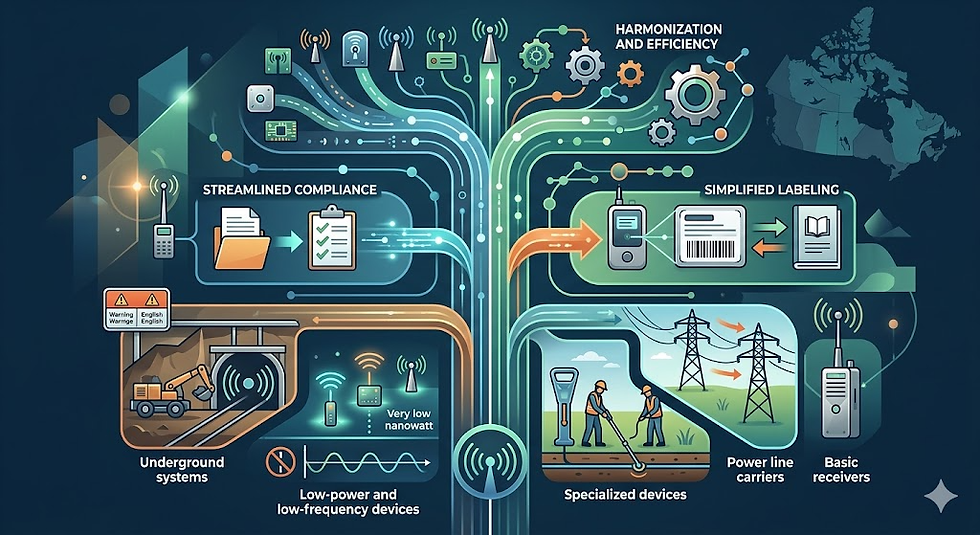
Streamlined Compliance and Reduced Administrative Burden
One of the most impactful changes is the removal of standalone test report requirements. Instead, manufacturers may rely on RSS-Gen provisions, which centralize compliance obligations. Labeling and user manual requirements have also been simplified through cross-referencing, reinforcing a modular regulatory structure.
Additionally, stand-alone receivers are now explicitly addressed. While they must comply with technical requirements under RSS-Gen, they benefit from exemptions related to labeling and test reports. Passive RFID tags are also incorporated into the standard, with clear exemptions recognizing their low-risk operational profile.
Targeted Requirements for Specialized Equipment
Issue 6 introduces more precise requirements for specific device categories. Underground radio systems, commonly used in mining operations, must include bilingual labeling restricting their use to underground environments. These systems must also ensure that radio-frequency emissions above ground remain within established field strength limits.
Clarifications have also been made for cable-locating equipment operating between 9 and 490 kHz and AC wire carrier current devices operating up to 30 MHz. These refinements aim to mitigate interference risks and improve coexistence with authorized spectrum users.
Low-Power and Low-Frequency Devices Under RSS-310 Issue 6 Canada
Another notable regulatory shift concerns devices previously excluded from ISED oversight. Transmitters with extremely low input power (6 nanowatts or less) and equipment operating below 9 kHz are no longer fully exempt. Instead, they are subject to partial regulation, with exemptions limited to labeling, user manuals, and test reports.
From a legal engineering perspective, this reflects a nuanced approach: rather than broad exclusions, regulators are implementing proportional requirements based on interference risk and technological impact.
Conclusion
RSS-310 Issue 6 represents a strategic evolution in Canada’s radio equipment regulatory framework. By integrating requirements with RSS-Gen and introducing targeted exemptions, ISED enhances both regulatory clarity and efficiency. For manufacturers, importers, and compliance professionals, this update underscores the importance of adopting a systems-based approach to regulatory compliance—where legal interpretation and engineering implementation are closely aligned.
