Moldova Spectrum Licensing: ANRCETI Establishes Competition Commission
On October 27, 2025, Moldova’s National Regulatory Agency for Electronic Communications and Information Technology (ANRCETI) announced the creation of a Competition Commission to supervise the issuance of licenses for several key radio frequency bands. The initiative is designed to enhance transparency and fairness in the country’s spectrum allocation process while supporting the expansion of advanced telecommunications networks.
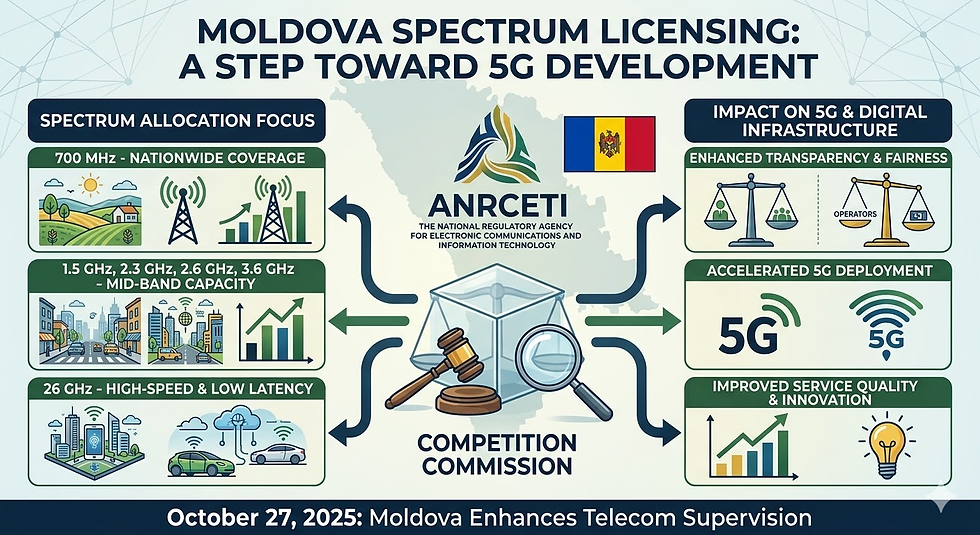
The new commission will oversee licensing procedures for multiple frequency bands that are essential for modern mobile communications. These include the 700 MHz, 1500 MHz, 2300 MHz, 2600 MHz, 3600 MHz, and 26 GHz bands. Each of these bands plays a significant role in enabling reliable connectivity and supporting next-generation services such as 5G.
Low-band spectrum like the 700 MHz band is highly valuable for nationwide coverage. Its strong propagation characteristics allow signals to travel long distances and penetrate buildings more effectively. This makes it particularly important for extending mobile broadband services to rural areas and improving indoor connectivity.
Mid-band spectrum—including 1500 MHz, 2300 MHz, 2600 MHz, and 3600 MHz—offers a balance between coverage and network capacity. These frequencies are widely used worldwide for high-speed mobile services and form a key foundation for many 5G deployments.
Meanwhile, the 26 GHz band belongs to the millimeter-wave spectrum range. Although it covers shorter distances, it enables extremely high data speeds and very low latency. This makes it suitable for dense urban environments, smart city infrastructure, and industrial connectivity applications.
Moldova Spectrum Licensing and Its Impact on 5G Development
The establishment of the Competition Commission is expected to improve oversight of the Moldova spectrum licensing process. By introducing a dedicated body to monitor licensing procedures, ANRCETI aims to ensure fair competition among telecommunications operators and maximize the efficient use of national spectrum resources.
For mobile network operators, access to these spectrum bands could support network expansion and improve service quality. The allocation of these frequencies may also encourage further investments in digital infrastructure and accelerate the deployment of advanced technologies across the country.
From a broader perspective, the initiative aligns Moldova with international regulatory practices where transparent spectrum allocation mechanisms help promote innovation and healthy market competition. As demand for high-speed connectivity continues to grow, efficient spectrum management will remain a crucial factor in enabling future telecommunications development.
