Kenya Type Approval: CA Signals Sample Waivers in 2026 Rules
Kenya Type Approval Update: Sample Waivers Under Consideration as Draft 2026 Type Approval Regulations Reach Validation Stage
Kenya is in the final phase of replacing its 2010 equipment approval rules, and discussions at the stakeholder validation forum on the draft Kenya Information and Communications (Type Approval of Electronic Communications Equipment) Regulations, 2026 point to a meaningful shift in practice: physical samples may no longer be automatically required for every application. For manufacturers that have faced strict sample enforcement since April 2026, this is a development worth planning around, with the important caveat that any waiver remains entirely at the discretion of the Communications Authority of Kenya.
Key points
Physical samples may no longer be an automatic requirement for every Kenya type approval application.
A sample waiver may be considered where the application includes a complete Technical Construction File (TCF), accredited test reports (CE, FCC, IEC and similar), and the equipment presents a lower regulatory risk profile.
Categories where waivers have reportedly been considered include networking equipment, Bluetooth devices, wireless audio systems and RF modules.
The final decision rests solely with CA, and every project is assessed individually.
The waiver approach has not been published as a formal rule. The 2026 Regulations are still in draft and no effective date has been announced.
Regulatory background: Kenya type approval and the 2026 KICA review
The Communications Authority of Kenya regulates the ICT sector under the Kenya Information and Communications Act (Cap 411A). All radio and telecommunications equipment must be type approved before it is sold, distributed or used in the country. The current framework is the Kenya Information and Communications (Importation, Type Approval and Distribution of Communications Equipment) Regulations, 2010, which the 2026 draft is intended to replace.
The Ministry of Information, Communications and the Digital Economy, in consultation with CA, has revised fifteen sets of subsidiary regulations under the Act. After a Regulatory Impact Assessment and an earlier round of public participation, the Ministry convened a virtual Stakeholder Validation Forum from 15 to 17 September 2026. The draft Type Approval of Electronic Communications Equipment Regulations, 2026 were scheduled for the first session on 15 September 2026.
This matters because of where Kenya stood earlier in the year. From April 2026, CA began strictly enforcing physical sample submission for all type approval applications. Applications without samples were being rejected, no general exemptions applied, and earlier approvals granted without samples were not accepted as precedent. The signals from the validation forum suggest a more risk-based approach is now emerging.
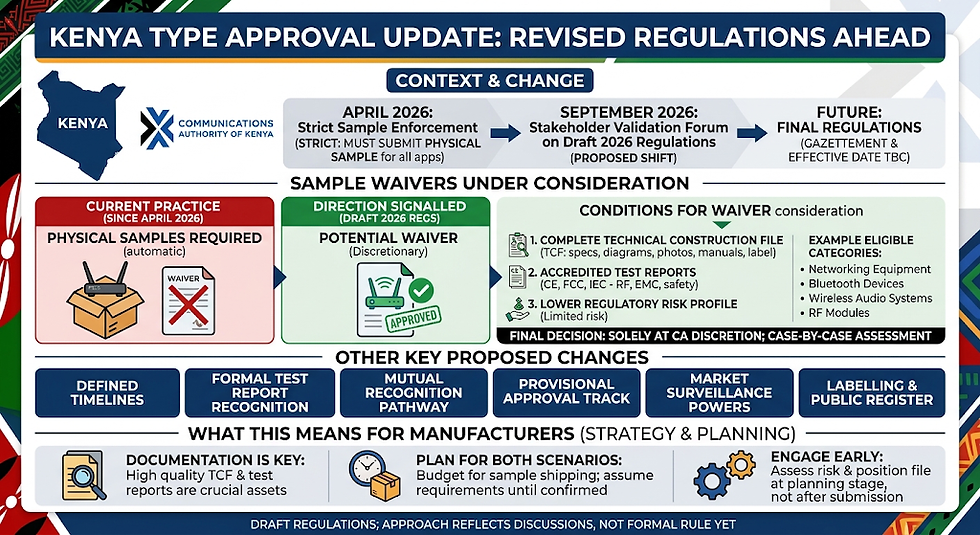
Sample waivers in the Kenya type approval process: what was discussed
Discussions at the forum indicated that applications may be considered for a sample waiver when three conditions are met:
A complete Technical Construction File. The TCF should fully describe the product, including specifications, block diagrams, schematics, photographs, user manual and labelling.
Accredited test reports. RF, EMC and safety reports issued by accredited laboratories against recognised schemes and standards such as CE, FCC and IEC.
A lower regulatory risk profile. The equipment category and its technical characteristics should present limited risk to networks, spectrum and users.
Recent practical cases suggest that waivers have been considered for networking equipment, Bluetooth devices, wireless audio systems and RF modules. In each case, the quality and completeness of the submitted documentation played a decisive role, both in supporting the waiver request and in avoiding delays during evaluation.
Two points of caution apply. First, a waiver is not an entitlement: CA decides case by case and can still request a sample at any stage. Second, the approach reflects forum discussions and recent casework rather than a published procedure, so applicants should not treat it as a guaranteed pathway.
Other proposed changes in the draft 2026 Regulations
Beyond the sample question, the draft is reported to modernise the wider framework. Proposed elements include defined evaluation timelines for complete applications, formal recognition of test reports from accredited laboratories, a mutual recognition pathway with foreign regulators, a provisional approval track for trials and demonstrations, labelling and public register requirements, and stronger market surveillance powers, including the ability to request samples and documentation from importers and distributors after approval. These provisions should be confirmed against the final gazetted text.
In parallel, CA consulted on draft Technical Specifications for Network Equipment, 2026, with comments closing on 30 September 2026. Networking equipment suppliers should track both instruments together.
Certification impact summary
Area | Practice since April 2026 | Direction signalled at the forum | Impact on applicants |
Physical samples | Required for all applications; applications without samples rejected | May be waived case by case for lower-risk equipment | Potential savings on shipping, customs clearance and lead time |
Documentation | Application form, test reports and manuals | Complete TCF becomes the basis for any waiver request | Higher expectations on file quality and completeness |
Test reports | Reports from accredited laboratories accepted | Accredited CE, FCC and IEC reports support waiver eligibility | Existing international reports can be leveraged more effectively |
Equipment categories | No general exemptions | Networking, Bluetooth, wireless audio and RF modules have been considered | Higher-risk categories should still plan for sample submission |
Decision making | Uniform enforcement | Discretionary, project-by-project assessment by CA | Outcome cannot be guaranteed in advance; early strategy is essential |
Existing certificates | Valid | No change indicated | No action required for approved models |
Legal framework | 2010 Regulations in force | Draft 2026 Regulations at validation stage | Further procedural changes expected once gazetted |
What this means for manufacturers
Documentation is now a strategic asset. A well-prepared TCF and accredited test reports no longer simply satisfy a checklist. They are the basis on which CA may agree to waive a sample, which makes file quality a direct driver of cost and schedule.
Plan for both scenarios. Because a waiver cannot be guaranteed, project plans and budgets should keep a sample available and allow time for shipping to Nairobi if CA requests one.
Expect category differences. Lower-risk products such as Bluetooth accessories, wireless audio devices, RF modules and networking equipment are the most likely candidates. Manufacturers of higher-risk equipment, for example mobile cellular devices and high-power transmitters, should assume samples will continue to be required.
Do not over-commit on timelines. Launch dates communicated to sales teams and distributors should reflect the standard process until a waiver is confirmed for the specific model.
Engage early. The approval strategy, including whether to request a waiver and how to position the file, is best defined at the planning stage rather than after submission.
Timeline and required actions
Regulatory timeline
Date | Milestone |
2010 | Current Importation, Type Approval and Distribution of Communications Equipment Regulations enter into force |
26 August 2025 | Public notice invites comments on the Regulatory Impact Assessment for the revised KICA regulations |
April 2026 | CA begins strict enforcement of physical sample submission for all type approval applications |
26 August 2026 | Ministry publishes notice of the Stakeholder Validation Forum on the draft 2026 regulations |
15 September 2026 | Draft Type Approval of Electronic Communications Equipment Regulations, 2026 presented for validation |
17 September 2026 | Validation forum concludes |
30 September 2026 | Comment period closes on draft Technical Specifications for Network Equipment, 2026 |
To be confirmed | Finalisation and publication of the 2026 Regulations in the Kenya Gazette; effective date not yet announced |
Required actions
When | Action | Responsible |
Now | Audit the TCF for each model destined for Kenya and close any gaps (schematics, block diagrams, photos, manuals, label artwork) | Regulatory / compliance team |
Now | Confirm that RF, EMC and safety reports are current, cover the exact model and variants, and come from accredited laboratories | Regulatory / test laboratory |
Before submission | Assess the equipment's risk profile and decide whether a waiver request is realistic | Regulatory team with local representative |
Before submission | Keep a sample ready and budget for logistics in case CA declines the waiver | Project / logistics |
During evaluation | Respond promptly to CA queries; incomplete responses are the most common source of avoidable delay | Local representative |
Ongoing | Monitor the gazettement of the 2026 Regulations and review labelling, timelines and surveillance obligations once final | Regulatory intelligence |
