India BIS IS 302 (Part 1): 2024 Deadline Now Feb 2027
- Jun 1
- 6 min read
India Extends BIS IS 302: 2024 Deadline for Appliance Adapters to February 2027
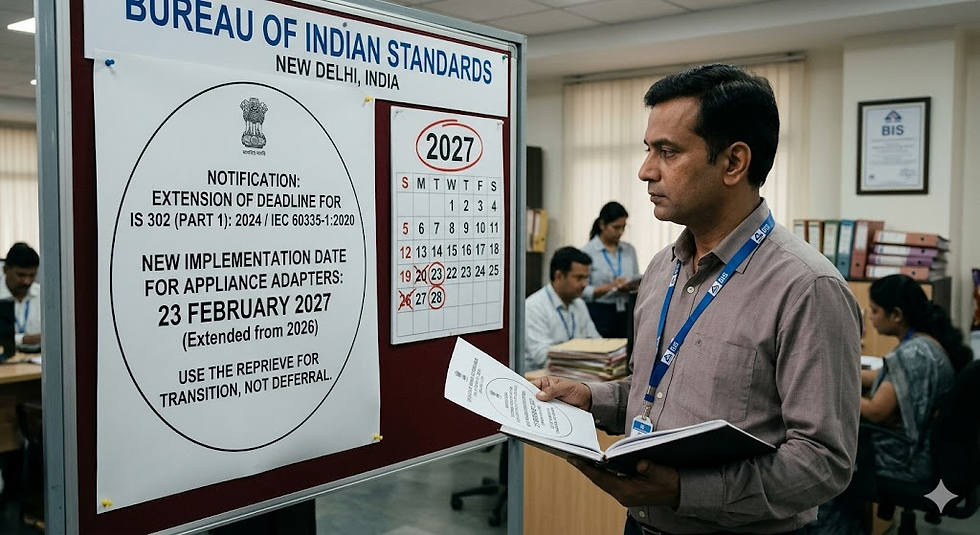
The Bureau of Indian Standards (BIS) has granted manufacturers another year of breathing room. In a Registration Department circular dated 21 January 2026, BIS extended the last date of implementation of the revised IS 302 (Part 1): 2024 / IEC 60335-1:2020 to 23 February 2027. The standard governs Adapters for Household and Similar Electrical Appliances, a product category covered under mandatory certification through Scheme II of the BIS (Conformity Assessment) Regulations, 2018.
For compliance teams, certification managers, and importers serving the Indian market, this is a meaningful — but finite — reprieve. All other conditions of the original implementation circular dated 27 November 2024 remain unchanged. The extra time should be used for transition work, not deferral.
Regulatory Context: How the Deadline Reached 2027
The revised standard did not appear overnight, and neither did this extension. The timeline matters because it defines the concurrent-running window during which both the old and new standards remain valid.
BIS first revised IS 302-1:2008, publishing it as IS 302 (Part 1): 2024 aligned with IEC 60335-1:2020, and set 23 February 2025 as the original last date for concurrent running. That date was pushed to 23 February 2026 by a circular dated 20 February 2025, and has now been extended a second time to 23 February 2027 under the 21 January 2026 circular. After this final date, IS 302-1:2008 stands withdrawn and no licence may operate against it.
In practical terms, the extension prolongs the period in which manufacturers may certify against either IS 302-1:2008 or IS 302 (Part 1): 2024. It does not soften the eventual cut-over; it simply moves it.
Technical Scope of the Revised IS 302 (Part 1): 2024
The revision aligns the Indian standard with the most recent edition of IEC 60335-1:2020 and introduces substantive technical changes well beyond editorial cleanup. Manufacturers re-testing lead models should expect their products to be evaluated against requirements that did not exist under the 2008 edition.
Electrical and Power-Measurement Requirements
The revision clarifies requirements for PELV (protected extra-low voltage) circuits and refines how power input and rated current are measured when they vary across the operating cycle. The previous Annex S has been replaced with an informative Annex S that provides guidance on measuring power input and current over the representative period defined in clauses 10.1 and 10.2. New limits have also been introduced on the output voltage of accessible safety extra-low voltage outlets, connectors, and USB ports under abnormal operating conditions.
Battery and Metal-Ion Charging Requirements
A significant addition is the introduction of requirements for battery-operated appliances, including a dedicated new Clause 12 covering the charging of metal-ion batteries. New definitions relating to battery charging, discharging, and remote functionality have been added (3.10, 3.11), reflecting the proliferation of rechargeable and connected appliances.
Mechanical Strength and Moisture Resistance
The standard now specifies mechanical strength requirements for appliances with integral pins for insertion into socket-outlets, along with corresponding moisture-resistance test criteria for those integral-pin designs. Moisture-resistance test requirements have also been introduced for appliances with an automatic cord reel carrying a second-numeral IP rating, and the humidity test now uses revised relative-humidity and temperature parameters (15.3), plus a rinsing agent in the moisture-resistance test (15.2).
Cybersecurity, Optical Radiation, and Software Evaluation
Three forward-looking annexes broaden the safety envelope. A new normative Annex U introduces cybersecurity requirements to prevent unauthorized access and address the effects of transmission failures over public networks. A new normative Annex T addresses UV-C radiation effects on non-metallic materials, and the standard now covers optical radiation hazards. Annex R on software evaluation has been revamped, and software Class C and Class B have been deleted.
Component and Interface Requirements
New component requirements have been added for telecommunication interface circuitry, thermal links, contactors and relays, lamps and lamp systems, and cord sets (clauses 24.1.7 through 24.1.11). Test probe 18 has been introduced, along with requirements for appliances incorporating user-accessible appliance outlets and socket-outlets, and for appliances incorporating a functional earth.
What This Means for Manufacturers
The headline is reassuring, an extra year, but the underlying obligation is unchanged and the work is non-trivial. Here is the practical reading for those holding or seeking BIS licences.
Existing licensees must implement the revised standard by 23 February 2027. Beyond that date, no licence remains operative unless compliance with IS 302 (Part 1): 2024 has been demonstrated. Demonstration requires complete test reports issued by a BIS-recognized laboratory for all lead models in the existing scope that were previously tested under IS 302-1:2008. Licensees must also submit an undertaking confirming that the revised requirements have been implemented across all other series models within the scope of the licence. Failure to complete these actions by the deadline triggers cancellation of the licence or deletion of the non-compliant model from scope.
New applicants face a tighter practical window than the headline date suggests. Applications filed under the old IS 302-1:2008 will be accepted only up to one month before the 23 February 2027 deadline. After the deadline, no licence will be granted against the old standard. Applications already in process under the 2008 edition may continue, provided the applicant submits an undertaking to changeover to the revised standard before the implementation date.
For change in scope of an existing licence, the rules for applicants apply, and processing under the old standard is permitted only up to the date the licensee switches over or the implementation date, whichever is earlier.
The strategic takeaway: treat the extension as runway for testing-lab scheduling, design changes (especially around integral pins, battery charging, and USB output limits), and documentation, not as permission to wait. Recognized-lab capacity tends to compress as deadlines approach.
Certification Impact Summary
Dimension | IS 302-1:2008 (outgoing) | IS 302 (Part 1): 2024 / IEC 60335-1:2020 (incoming) |
Aligned IEC edition | Older IEC 60335-1 base | IEC 60335-1:2020 |
Battery / metal-ion charging | Not addressed | New Clause 12; new definitions (3.10, 3.11) |
Cybersecurity | Not addressed | New normative Annex U |
UV-C / optical radiation | Not addressed | New Annex T; optical radiation hazard clauses |
Software evaluation | Class B/C framework | Revamped Annex R; Classes B and C deleted |
Integral-pin mechanical / moisture tests | Limited | New mechanical strength + moisture criteria |
SELV/USB output under abnormal conditions | Not limited | New output-voltage limits |
Component requirements | Baseline | New requirements (24.1.7–24.1.11) |
Test probe | — | Test probe 18 introduced |
Concurrent running ends | 23 February 2027 | Mandatory from 24 February 2027 |
Action for existing licensees | — | Re-test all lead models at BIS-recognized lab + undertaking |
Timeline and Required Actions
Use the following sequence to stay ahead of the cut-over. Dates are fixed; lab capacity is not.
Now – Q3 2026: Gap assessment. Map each lead model and series model against the new battery, cybersecurity, moisture, integral-pin, and USB-output requirements. Identify which designs need physical or documentation changes.
Q3 2026: Book recognized-lab capacity. Engage a BIS-recognized laboratory early and reserve testing slots for all lead models. Capacity for IS 302 (Part 1): 2024 testing will tighten as the deadline nears.
Q4 2026: Complete lead-model testing. Obtain complete test reports under IS 302 (Part 1): 2024 / IEC 60335-1:2020 for every lead model in the licence scope.
Q4 2026 – Q1 2027: Prepare undertakings. Document and sign the undertaking confirming the revised requirements are implemented across all other series models in scope.
By 23 January 2027 (new applicants): File any remaining applications under IS 302-1:2008 — this is the one-month-before cut-off. After this point, apply only under the revised standard.
By 23 February 2027: Ensure full compliance is on record with BIS for all models. From 24 February 2027, IS 302-1:2008 is withdrawn; non-compliant models risk licence cancellation or removal from scope.
Broader Market Significance
IS 302 (Part 1) is the general (Part 1) safety standard that underpins the wider IS 302 series for household and similar electrical appliances in India. Adapters covered here are a gateway product, many appliances depend on the same horizontal requirements, so alignment with IEC 60335-1:2020 ripples across the certification framework.
For global manufacturers, the alignment is a net simplification over time: a product engineered to IEC 60335-1:2020 for other markets is far closer to BIS conformity than one built to the 2008 baseline. The additions on cybersecurity, metal-ion battery charging, and USB output limits also signal where Indian conformity assessment is heading, toward connected, rechargeable, and software-bearing appliances. Manufacturers that fold these requirements into design now will face fewer surprises across India's expanding mandatory-certification scope, and will protect uninterrupted access to one of the world's largest appliance markets when the 2027 cut-over arrives.
