Ethiopia Telecom Market: Opportunities, Regulations & Entry Strategy
- 18 hours ago
- 6 min read
Ethiopia's telecom market is no longer a distant frontier — it is one of the most actively pursued opportunities in global telecommunications. After decades of operating under a state monopoly, the sector has been fundamentally restructured. New operators have entered, infrastructure investment is accelerating, and regulators are establishing frameworks to govern a rapidly evolving landscape.
For device manufacturers, component exporters, and telecom solution providers, this shift represents both a compelling market entry opportunity and a compliance challenge that cannot be underestimated. This article breaks down what is driving the Ethiopia telecom market, what the regulatory environment demands, and what your company must do to compete effectively.
From Monopoly to Liberalization: Understanding the Ethiopia Telecom Market Shift
For most of its modern history, Ethiopia's telecom sector was controlled exclusively by Ethio Telecom, a state-owned operator. This monopoly structure limited investment, constrained infrastructure development, and kept connectivity rates among the lowest in sub-Saharan Africa.
That era has ended. The government launched a comprehensive telecom reform program and established the Ethiopian Communications Authority (ECA) — the independent regulator responsible for licensing operators, managing spectrum, and certifying devices. The reform has produced several landmark outcomes:
• The market was opened to private and foreign operators for the first time
• New operating licenses were issued to competitive carriers
• A formal device certification regime was introduced
• The digital economy was elevated as a national strategic priority
The pattern mirrors liberalization episodes in India, Myanmar, and Rwanda — markets where opening the sector triggered years of infrastructure investment and rapid subscriber growth. In Ethiopia, with a population exceeding 120 million and historically low penetration rates, the potential scale is exceptional.
Why the Ethiopia Telecom Market Is Attracting Global Players
1. Population Scale and Low Baseline Penetration
Ethiopia is the second most populous country in Africa. Despite this, internet penetration and smartphone adoption have remained low relative to comparable markets. This creates a distinctive dynamic: demand will come primarily from first-time users rather than device replacement cycles, which means growth rates in the coming years are likely to outperform markets where saturation has already occurred.
2. New Operators Driving Infrastructure Investment
The entry of Safaricom Telecommunications Ethiopia — backed by a consortium of global investors including Vodacom, Vodafone, and CDC Group — marked a turning point. Competition between Safaricom Ethiopia and Ethio Telecom is accelerating network rollout, improving service quality, and driving demand for compatible hardware across all device categories, from handsets to routers to IoT modules.
3. Government-Led Digital Economy Agenda
Ethiopia's government has made the digital economy a central pillar of its development strategy. Programs targeting mobile money adoption, digital identity infrastructure, and e-government service delivery are creating structural demand for connected devices. This is not speculative — it is policy-backed and budget-supported demand that benefits manufacturers in the right device categories.
ECA Type Approval: The Critical Barrier for Entering the Ethiopia Telecom Market
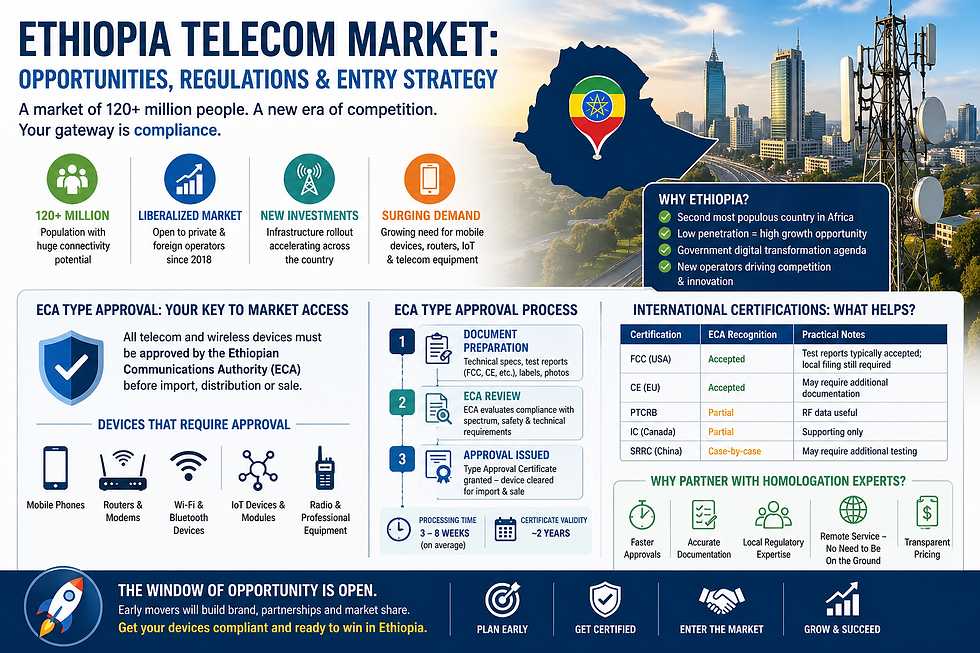
Access to the Ethiopia telecom market is not simply a question of logistics and pricing. Any device that transmits radio frequency signals or connects to a network must obtain Type Approval certification from the Ethiopian Communications Authority before it can be legally imported, distributed, or sold.
This requirement applies across a broad product scope:
• Smartphones and feature phones
• Routers, modems, and CPE equipment
• Wi-Fi and Bluetooth-enabled devices
• IoT sensors, modules, and connected hardware
• Radio communication and professional telecom equipment
The ECA certification process evaluates whether a device meets spectrum usage requirements, does not interfere with network infrastructure, complies with applicable safety standards, and is compatible with local systems and frequency allocations. Devices that have not completed this process cannot be legally placed on the Ethiopian market, regardless of whether they hold certifications from other jurisdictions.
Certification Impact Summary
Understanding how existing international certifications interact with ECA requirements is essential for accurate market entry planning. The table below summarizes the practical impact of the most common international certifications:
Certification | ECA Recognition | Practical Notes |
FCC (USA) | Accepted | Test reports typically accepted; local filing still required |
CE (EU) | Accepted | Widely recognized; may require supplementary documentation |
PTCRB | Partial | RF test data accepted; full ECA application still required |
IC (Canada) | Partial | Supports submission but does not replace ECA certificate |
SRRC (China) | Partial | Reviewed case-by-case; additional testing may be requested |
Holding an international certification accelerates the ECA review but does not eliminate the requirement. Manufacturers should budget for a dedicated Ethiopian submission regardless of existing approvals.
How the ECA Type Approval Process Works
Step 1 — Documentation Submission
The applicant submits a comprehensive technical file including product specifications, test reports from accredited laboratories, product photos, and labeling samples. Reports from internationally recognized bodies such as FCC or CE are typically accepted as supporting evidence.
Step 2 — Regulatory Review
The ECA reviews the submitted documentation against local compliance standards. Depending on the product category and completeness of the submission, additional testing or clarifications may be requested at this stage.
Step 3 — Certificate Issuance
Once the review is complete and all requirements are satisfied, the ECA issues a Type Approval Certificate. The certificate authorizes the legal import and sale of the device model in Ethiopia. Approval timelines range from approximately three to eight weeks, and certificates carry a validity period of typically two years, after which renewal is required.
What This Means for Manufacturers
The certification requirement has direct and practical implications for how manufacturers approach market entry in Ethiopia. Several key business realities follow from the ECA framework:
Market access is conditional. No device can be imported or sold commercially without a valid ECA Type Approval Certificate. This applies whether you are shipping directly to distributors or entering through a local partner.
Lead time must be planned. The approval window of three to eight weeks means certification must begin well before intended launch dates. Companies that treat certification as an afterthought will face delays that cost market position.
International certifications are a starting point, not an endpoint. Existing FCC or CE approvals reduce friction but do not substitute for ECA certification. A separate submission is mandatory.
Early movers gain structural advantages. Manufacturers who obtain certification ahead of competitors can secure distribution partnerships, build brand recognition, and establish pricing benchmarks before the market becomes crowded.
Compliance expertise is a competitive differentiator. Given the complexity of local regulations, language barriers (Amharic), and evolving requirements, companies that work with experienced homologation partners consistently achieve faster approvals and fewer rejections than those attempting the process independently.
Real Challenges Companies Face in the Ethiopia Telecom Market
Any honest assessment of the Ethiopia telecom market must acknowledge the operational challenges that accompany the opportunity. These are the issues that most market overviews underreport:
• Regulatory evolution: The ECA's requirements have developed rapidly in line with the sector's liberalization. Rules that applied last year may have been updated, and interpretations can vary. Companies must maintain current knowledge of the regulatory framework rather than relying on outdated information.
• Documentation completeness: Incomplete or incorrectly formatted submissions are the most common cause of delays. Not all international test reports are automatically accepted, and specific labeling or technical documentation standards must be met.
• Import and logistics complexity: Customs procedures for telecom equipment require careful documentation. Foreign exchange availability can affect the timing and cost of imports.
• Local coordination requirements: In some product categories, local representation is required or practically necessary. Working with a partner who understands both the language and regulatory culture reduces friction significantly.
Timeline and Required Actions for Market Entry
The following framework provides a practical roadmap for manufacturers seeking to enter the Ethiopia telecom market through compliant channels:
Phase | Required Actions | Estimated Timeline |
Phase 1 | Market & regulatory assessment — confirm product scope, identify ECA requirements, review existing certifications | Weeks 1–2 |
Phase 2 | Documentation preparation — compile technical specs, lab reports, labeling, and product photos to ECA standards | Weeks 3–5 |
Phase 3 | ECA submission — file application with the Ethiopian Communications Authority through local representative | Week 6 |
Phase 4 | Regulatory review — respond to any clarification requests; typical review window is 3–8 weeks | Weeks 7–13 |
Phase 5 | Certificate issuance — receive Type Approval Certificate; valid for approximately 2 years | Week 14 (est.) |
Phase 6 | Commercial launch — complete import documentation, engage local distributors, begin sales | Week 15+ |
The Early Mover Advantage: Real, But Not Risk-Free
Ethiopian market entry carries genuine early-mover advantages. Distributors in emerging markets tend to form exclusive or semi-exclusive relationships with the first credible suppliers who approach them. Brand recognition built during the market's growth phase compounds over time. And regulatory relationships — the familiarity that comes from being a known, compliant operator — provide practical benefits that latecomers cannot easily replicate.
However, these advantages must be weighed against the risks that any honest market assessment must include: regulatory frameworks that are still maturing, infrastructure constraints outside major urban centers, and macroeconomic factors including foreign exchange availability that can affect import operations.
The appropriate strategic framing is not "enter immediately" or "wait and see" — it is "build regulatory readiness now, so that commercial entry can happen decisively when the moment is right."
Conclusion: Regulatory Readiness Is the Real Competitive Advantage
Ethiopia's telecom market is genuinely one of the most significant emerging opportunities in global telecommunications. The combination of population scale, low baseline penetration, active new entrants, and government-driven digital adoption creates conditions for sustained, multi-year growth across device categories.
The companies that will benefit most are not necessarily those with the most competitive products or prices. They are the ones that understand the regulatory landscape, complete ECA type approval efficiently, and establish market presence before the window narrows.
If your organization is evaluating the Ethiopia telecom market and needs guidance on device certification, ECA type approval processes, or homologation strategy, our team can help you move from assessment to approval with minimal delays.